camba
See also: Camba
Galician
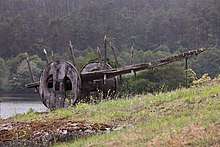
A Galician traditional ox cart
Etymology
From Proto-Celtic *kambos (“curved”). Cognate with Old Irish camm (“crooked, bent”), Welsh cam (“crooked”).[1]
Pronunciation
- IPA(key): /ˈkamba̝/
Noun
camba f (plural cambas)
- each one of the bent pieces of the felly (in a traditional wooden wheel)
- doorjamb of the oven
- handmill
- curved beam of the plough
Related terms
References
- “camba” in Dicionario de Dicionarios da lingua galega, SLI - ILGA 2006-2013.
- “camba” in Santamarina, Antón (coord.): Tesouro informatizado da lingua galega. Santiago de Compostela: Instituto da Lingua Galega.
- “camba” in Álvarez, Rosario (coord.): Tesouro do léxico patrimonial galego e portugués, Santiago de Compostela: Instituto da Lingua Galega.
- ↑ Coromines, Joan; Pascual, José A. (1991–1997). Diccionario crítico etimológico castellano e hispánico. Madrid: Gredos, s.v. cama II.
Occitan
Pronunciation
- IPA(key): [ˈkambo]
Noun
camba f (plural cambas)
Portuguese
Verb
camba
- third-person singular (ele and ela, also used with você and others) present indicative of cambar
- second-person singular (tu, sometimes used with você) affirmative imperative of cambar
Spanish
Etymology
Noun
camba m (plural cambas)
- (vesre) pimp
This article is issued from
Wiktionary.
The text is licensed under Creative Commons - Attribution - Sharealike.
Additional terms may apply for the media files.