bunting
See also: Bunting
English
Pronunciation
Etymology 1
.jpg)
Bunting on display for day 3 of the 2012 Olympic torch relay, in Devon, UK
Possibly from dialect bunting (“sifting flour”), from Middle English bonten (“to sift”), hence the material used for that purpose.
Noun
bunting (countable and uncountable, plural buntings)
- Strips of material used as festive decoration, especially in the colours of the national flag.
- (nautical) A thin cloth of woven wool from which flags are made; it is light enough to spread in a gentle wind but resistant to fraying in a strong wind.
- Flags considered as a group.
Translations
strips of material hung as decoration
material from which flags are made
|
|
flags as a group
|
Etymology 2
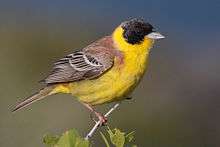
A black-headed bunting (Emberiza melanocephala)
[From circa 1300], from bountyng, of unknown origin. Possibly from buntin (“plump”) (compare baby bunting, Scots buntin (“short and thick”), Welsh bontin (“rump”) and bontinog (“big-arsed”)), or a double diminutive of French bon. Or possibly a reference to speckled plumage, from an unrecorded Old English word akin to German bunt (“multi-coloured”), Dutch bont.[1]
Noun
bunting (plural buntings)
- Any of various songbirds, mostly of the genus Emberiza, having short bills and brown or gray plumage.
Derived terms
Translations
bird
Etymology 3
See bunt.
Verb
bunting
- present participle of bunt
References
This article is issued from
Wiktionary.
The text is licensed under Creative Commons - Attribution - Sharealike.
Additional terms may apply for the media files.