bronze
English
Etymology
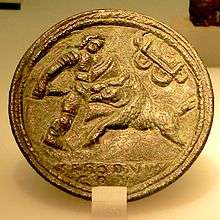
1730-40; from French bronze (1511), from Italian bronzo (13th cent.); see it for more.
Pronunciation
Noun
bronze (countable and uncountable, plural bronzes)
- (uncountable) A natural or man-made alloy of copper, usually of tin, but also with one or more other metals.
- (countable and uncountable) A reddish-brown colour, the colour of bronze.
- bronze colour:
- (countable) A work of art made of bronze, especially a sculpture.
- A bronze medal.
- Boldness; impudence; brass.
- Alexander Pope
- Embrown'd with native bronze, lo! Henley stands.
- Alexander Pope
Translations
|
|


- The translations below need to be checked and inserted above into the appropriate translation tables, removing any numbers. Numbers do not necessarily match those in definitions. See instructions at Wiktionary:Entry layout#Translations.
|
|
Adjective
bronze (comparative more bronze, superlative most bronze)
- Made of bronze metal.
- 1907, Robert William Chambers, chapter I, in The Younger Set (Project Gutenberg; EBook #14852), New York, N.Y.: D. Appleton & Company, published 1 February 2005 (Project Gutenberg version), OCLC 24962326:
- The house was a big elaborate limestone affair, evidently new. Winter sunshine sparkled on lace-hung casement, on glass marquise, and the burnished bronze foliations of grille and door.
-
- Having a reddish-brown colour.
- (of the skin) Tanned; darkened as a result of exposure to the sun.
- 2016, Kit Moulton, Annabella (page 108)
- That girl was dynamite. Dark hair with killer blue eyes, bronze skin, and an exquisite full-figured body.
- 2016, Kit Moulton, Annabella (page 108)
Derived terms
Translations
Verb
bronze (third-person singular simple present bronzes, present participle bronzing, simple past and past participle bronzed)
- (transitive) To plate with bronze.
- My mother bronzed my first pair of baby shoes.
- (transitive) To color bronze; (of the sun) to tan.
- 1925, DuBose Heyward, Porgy, London: Jonathan Cape, Part IV, p. 137,
- The sun was so low that its level rays shot through the tunnels of the forest and bronzed its ceiling of woven leaves when Bess returned to the clearing.
- 1961, Freya Stark, Dust in the Lion's Paw: Autobiography 1939-1946, New York: Harcourt, Brace & World, Chapter 8, p. 122,
- North is the bay of Acre, lovely in shape, and, far, far beyond, the cloudy vision of Hermon, its huge landscape now only attainable with a police pass—beautifully solitary except for good-looking young men of the police patrols, all fit and bronzed.
- 1925, DuBose Heyward, Porgy, London: Jonathan Cape, Part IV, p. 137,
- (intransitive, of the skin) To change to a bronze or tan colour due to exposure to the sun.
- 2006, Melissa Lassor, "Out of Darkness", page 124 in Watching Time
- His skin began to bronze as he worked in our garden each day.
- 2006, Melissa Lassor, "Out of Darkness", page 124 in Watching Time
- (transitive) To make hard or unfeeling; to brazen.
- Sir Walter Scott
- the lawyer who bronzes his bosom instead of his forehead
- Sir Walter Scott
Translations
See also
Anagrams
Catalan
Alternative forms
Pronunciation
Noun
bronze m (plural bronzes)
- bronze (metal)
- bronze medal
Derived terms
- bronzejar-se
- bronzejat
- Edat del bronze
Danish
Etymology
Pronunciation
- IPA(key): /brɔnɡsə/, [ˈb̥ʁʌŋsə]
Noun
bronze c (singular definite bronzen, plural indefinite bronzer)
- (uncountable) bronze (element; colour)
- (countable) bronze (work of art made of bronze), bronze medal
Inflection
Further reading

French
Etymology
Pronunciation
- IPA(key): /bʁɔ̃z/
Noun
bronze m (plural bronzes)
- bronze (metal, work of art)
Derived terms
- mouler un bronze
Further reading
- “bronze” in le Trésor de la langue française informatisé (The Digitized Treasury of the French Language).
Anagrams
Greenlandic
Etymology
Borrowed from Danish bronze; see English bronze etymology
Noun
bronze
Portuguese
Etymology
Borrowed from French bronze, from Italian bronzo, either from Byzantine Greek βροντησίον (brontēsíon), presumably from Βρεντήσιον (Brentḗsion, “Brindisi”), known for the manufacture of bronze; or ultimately from Persian برنج (birinj, biranj, “brass”) ~ پرنگ (piring, “copper”).
Pronunciation
- (Brazil) IPA(key): /ˈbɾõ.zi/
- (South Brazil) IPA(key): /ˈbɾõ.ze/
- (Portugal) IPA(key): /ˈbɾõ.zɨ/
Noun
bronze m (plural bronzes)