aste
Basque
Pronunciation
- IPA(key): /ˈas̺.te/
Noun
aste
Declension
"aste"
| |||||||||||||||||||||||||||||||||||||||||||||||||||||||||||||||||||||||||||||||
Derived terms
Estonian
Etymology 1
Noun
aste (genitive aste, partitive astet)
- a step
Declension
| singular | plural | |
|---|---|---|
| nominative | aste | asted |
| accusative | aste | asted |
| genitive | aste | astete |
| partitive | astet | asteid |
| illative | astesse | astetesse asteisse |
| inessive | astes | astetes asteis |
| elative | astest | astetest asteist |
| allative | astele | astetele asteile |
| adessive | astel | astetel asteil |
| ablative | astelt | astetelt asteilt |
| translative | asteks | asteteks asteiks |
| terminative | asteni | asteteni |
| essive | astena | astetena |
| abessive | asteta | asteteta |
| comitative | astega | astetega |
Etymology 2
Noun
aste (genitive astme, partitive astet)
Declension
| singular | plural | |
|---|---|---|
| nominative | aste | astmed |
| accusative | astme | astmed |
| genitive | astme | astmete |
| partitive | astet | astmeid |
| illative | astmesse | astmetesse astmeisse |
| inessive | astmes | astmetes astmeis |
| elative | astmest | astmetest astmeist |
| allative | astmele | astmetele astmeile |
| adessive | astmel | astmetel astmeil |
| ablative | astmelt | astmetelt astmeilt |
| translative | astmeks | astmeteks astmeiks |
| terminative | astmeni | astmeteni |
| essive | astmena | astmetena |
| abessive | astmeta | astmeteta |
| comitative | astmega | astmetega |
Derived terms
Finnish
Etymology
From the verb astua.
Pronunciation
- Rhymes: -ɑste
- Hyphenation: as‧te
- IPA(key): /ˈɑste(ʔ)/
Noun
aste
- grade
- degree
- (everyday usage) degree, degree Celsius (short for celsiusaste)
- order
Declension
| Inflection of aste (Kotus type 48/hame, no gradation) | |||
|---|---|---|---|
| nominative | aste | asteet | |
| genitive | asteen | asteiden asteitten | |
| partitive | astetta | asteita | |
| illative | asteeseen | asteisiin asteihin | |
| singular | plural | ||
| nominative | aste | asteet | |
| accusative | nom. | aste | asteet |
| gen. | asteen | ||
| genitive | asteen | asteiden asteitten | |
| partitive | astetta | asteita | |
| inessive | asteessa | asteissa | |
| elative | asteesta | asteista | |
| illative | asteeseen | asteisiin asteihin | |
| adessive | asteella | asteilla | |
| ablative | asteelta | asteilta | |
| allative | asteelle | asteille | |
| essive | asteena | asteina | |
| translative | asteeksi | asteiksi | |
| instructive | — | astein | |
| abessive | asteetta | asteitta | |
| comitative | — | asteineen | |
Derived terms
Anagrams
Gothic
Romanization
astē
- Romanization of 𐌰𐍃𐍄𐌴
Italian
Noun
aste f
- plural of asta
Anagrams
Karelian
Etymology
Compare Finnish aste.
Noun
aste (genitive astien, partitive astettu)
Latvian
_Airplane_Tail_-_Feb_2013.jpg)
Etymology
Originally an e-stem variant of an earlier i/n-stem *astis, from Proto-Baltic *asti- < *aš-sti-. Further, two possible Proto-Indo-European sources have been proposed: (a) *aḱ-sti-, from *aḱ- “sharp, pointy, edgy; stone” (whence also ass “sharp”, q.v.), with the meaning changes being “sharp, pointy (object)” > “stinger” > “tail”; and (b) *ost(h)- < *Host(H)-, *h₃ésth₁- “bone,” in which case the semantic evolution would have been “bone” > “tail bone” > “tail” (cf. Icelandic rōfa “dog's, cat's tail” from Old Norse rófa “bony part of a horse's tail”). In the (a) case, cognates would include Lithuanian akstìs (“skewer, fish bone”) akštìs (“skewer, fish bone, awn”), Old Church Slavonic осътъ (osŭtŭ, “thorny water plant”), остъ (ostŭ, “awn, stinger, fish bone”), Russian ость (ostʹ), Czech osť, Polish ość, Russian осот (osot, “thorny plant”), Bulgarian осът (ósǎt), Czech, Polish oset. In the (b) case, cognates would include Hittite *ḫaštai, Sanskrit अस्थि (अस्थि), Ancient Greek ὀστέον (ostéon), Albanian asht, Tocharian B āsta, Latin os (and maybe also costa “rib”), and perhaps also all the (a) cognates, which some authors also derive from Proto-Indo-European *Host(H)-, *h₃ésth₁-.[1]
Pronunciation
- IPA(key): [astɛ]
| (file) |
Noun
aste f (5th declension)
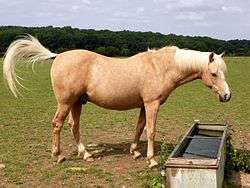
- (anatomy) (long) tail
- zirga aste ― horse tail
- suņa aste ― dog tail
- vilka aste ― wolf tail
- gaiļa aste ― rooster tail
- pāva aste ― peacock tail
- kaķis pa to laiku bija izlavījies no pagalma un, izlējis asti, lēni gāja prom ― the cat, meanwhile, had gotten out of the yard and, straightening (his) tail, slowly went away
- kas sunim asti cels, ja pats necels ― who is going to raise a dog's tail if not for the dog himself
-
- (of objects) tail (extended part at the end)
- lidmašīnas aste ― airplane tail
- kleitas aste ― dress tail
- komētas aste ― comet's tail
- garas rindas stāvēja pie kasēm... paša astē iestājās arī tēvs ― there were long lines at the cashiers... father joined at the very tail (= end) (of one of the lines)
-
Usage notes
Basically, aste refers to long tails like a horse's, while ļipa refers to short tails like a rabbit's.
Declension
Synonyms
Derived terms
References
- ↑ Karulis, Konstantīns (1992), “aste”, in Latviešu Etimoloģijas Vārdnīca (in Latvian), Rīga: AVOTS, →ISBN
Mauritian Creole
Etymology
Verb
aste
- to buy
Reference
- Baker, Philip & Hookoomsing, Vinesh Y. 1987. Dictionnaire de créole mauricien. Morisyen – English – Français
Northern Sami
Pronunciation
- (Kautokeino) IPA(key): /ˈasːte/
Verb
aste
- inflection of astat:
- first-person dual present indicative
- third-person plural past indicative
Seychellois Creole
Etymology
Verb
aste
- to buy
Reference
- Danielle D’Offay et Guy Lionnet, Diksyonner Kreol - Franse / Dictionnaire Créole Seychellois - Français
Swahili
Adjective
aste
- slow (not quick in motion)
This Swahili entry was created from the translations listed at slow. It may be less reliable than other entries, and may be missing parts of speech or additional senses. Please also see aste in the Swahili Wiktionary. This notice will be removed when the entry is checked. (more information) July 2009