alligator
English
Etymology 1
From early Modern English alligater, alligarta, aligarto, alegarto, alagarto, from Spanish el lagarto (“the lizard”), from Latin lacertus (“lizard”), modern spelling possibly influenced by the unrelated Latin alligator (“one who binds”).
Pronunciation
- (Received Pronunciation) IPA(key): /ˈæ.lɪ.ɡeɪ.tə/
- (General American) enPR: ălʹĭ-gā-tər, IPA(key): /ˈæl.ɪ.ɡeɪ.ɾɚ/
Audio (US) (file) - Hyphenation: al‧li‧ga‧tor
Noun
alligator (plural alligators)
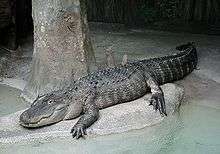
- Either of two species of large amphibious reptile, Alligator mississippiensis or Alligator sinensis, in the genus Alligator within order Crocodilia, which have sharp teeth and very strong jaws and are native to the Americas and China, respectively.
- All you could see of the alligator were its two eyes above the water, and suddenly it snatched up and caught the poor bird with its strong jaws full of sharp teeth.
- 2002, Maurice Burton, Robert Burton, International Wildlife Encyclopedia, page 38,
- Alligators and crocodiles look extremely alike.
- The main distinguishing feature is the teeth. In a crocodile the teeth in its upper and lower jaws are in line, but in an alligator, when its mouth is shut, the upper teeth lie outside the lower ones.
- 2007, Bernie McGovern (editor), Florida Almanac: 2007-2008, 17th Edition, page 243,
- In 1967, the federal government declared alligators to be an Endangered Species and prohibited gator hunting and the sale of hides. The alligator responded and by the mid-1970s, the reptile numbers soared to an estimated half-million.
- 2012, Thomas N. Tozer, Pierre's Journey to Florida: Diary of a Young Huguenot in the Sixteenth Century, unnumbered page,
- They ran to the village screaming at the top of their lungs that an alligator was coming after them. Several of the men in Alimacani retrieved from a storehouse the tool they used to catch alligators.
- Any of various machines with strong jaws, one of which opens like the movable jaw of an alligator.
- Any of various vehicles that have relatively long, low noses in front of a cab or other, usually windowed, structure.
Synonyms
- (reptile within Crocodilia): gator (informal)
Coordinate terms
Derived terms
|
|
|
Translations
|
|
Verb
alligator (third-person singular simple present alligators, present participle alligatoring, simple past and past participle alligatored)
- (intransitive, of paint or other coatings) To crack in a pattern resembling an alligator's skin.
- 2003, Carson Dunlop & Associates, Essentials of Home Inspection: Roofing, page 24,
- Alligatoring is a result of the sun making the top surface of the asphalt brittle.
- 2004, James E. Piper, Handbook of Facility Assessment, page 39,
- Sealing an area that is alligatoring is a temporary solution that may delay having to replace the asphalt for several years. A more permanent repair would be to replace the alligatored section.
- 2009, Kären M. Hess, Christine M. H. Orthmann, Criminal Investigation, page 483,
- Common burn indicators include alligatoring, crazing, the depth of char, lines of demarcation, sagged furniture springs and spalling.
- 2003, Carson Dunlop & Associates, Essentials of Home Inspection: Roofing, page 24,
Interjection
alligator
- Used in a common chronometric counting scheme, in which each iteration is sequentially numbered and supposed to be approximately one second in length.
References
- “Alligator” in Michael Quinion, Ballyhoo, Buckaroo, and Spuds: Ingenious Tales of Words and Their Origins, Washington, D.C.: Smithsonian Books in association with Penguin Books, 2004, →ISBN.
- alligator in The Century Dictionary, The Century Co., New York, 1911
- “alligator” in Douglas Harper, Online Etymology Dictionary, 2001–2018.
Etymology 2
Borrowed from Latin alligātor.
Noun
alligator (plural alligators)
See also
Danish
Noun
alligator c (singular definite alligatoren, plural indefinite alligatorer)
Declension
| common gender |
Singular | Plural | ||
|---|---|---|---|---|
| indefinite | definite | indefinite | definite | |
| nominative | alligator | alligatoren | alligatorer | alligatorerne |
| genitive | alligators | alligatorens | alligatorers | alligatorernes |
References
Dutch
Pronunciation
Audio (file)
Noun
alligator m (plural alligators, diminutive alligatortje n)
French
Etymology
Pronunciation
- IPA(key): /a.li.ɡa.tɔʁ/
audio (file)
Noun
alligator m (plural alligators)
- alligator (animal)
Further reading
- “alligator” in le Trésor de la langue française informatisé (The Digitized Treasury of the French Language).
Latin
Alternative forms
Etymology
Pronunciation
- (Classical) IPA(key): /ˌal.liˈɡaː.tor/
Noun
alligātor m (genitive alligātōris); third declension
Inflection
Third declension.
| Case | Singular | Plural |
|---|---|---|
| nominative | alligātor | alligātōrēs |
| genitive | alligātōris | alligātōrum |
| dative | alligātōrī | alligātōribus |
| accusative | alligātōrem | alligātōrēs |
| ablative | alligātōre | alligātōribus |
| vocative | alligātor | alligātōrēs |
Descendants
- Translingual: Alligator
References
- alligator in Charlton T. Lewis and Charles Short (1879) A Latin Dictionary, Oxford: Clarendon Press
Norwegian Bokmål
Etymology
From Spanish el lagarto (“the lizard”), via English alligator
Noun
alligator m (definite singular alligatoren, indefinite plural alligatorer, definite plural alligatorene)
References
- “alligator” in The Bokmål Dictionary.
Norwegian Nynorsk
Etymology
From Spanish el lagarto (“the lizard”), via English alligator
Noun
alligator m (definite singular alligatoren, indefinite plural alligatorar, definite plural alligatorane)
References
- “alligator” in The Nynorsk Dictionary.
Swedish
Noun
alligator c
- alligator (animal)
Declension
| Declension of alligator | ||||
|---|---|---|---|---|
| Singular | Plural | |||
| Indefinite | Definite | Indefinite | Definite | |
| Nominative | alligator | alligatorn | alligatorer | alligatorerna |
| Genitive | alligators | alligatorns | alligatorers | alligatorernas |
West Frisian
Noun
alligator c (plural alligators)