Europa
English
Etymology
From Ancient Greek Εὐρώπη (Eurṓpē), a character in Greek mythology.
Pronunciation
- IPA(key): /jʊˈɹoʊpə/
-
Audio (file)
Proper noun
Europa
- (Greek mythology) A Phoenician princess abducted to Crete by Zeus.
- (astronomy) A moon of Jupiter.
- (astronomy) 52 Europa, a main belt asteroid; not to be confused with the Jovian moon.
Derived terms
Translations
Afrikaans
Etymology
Proper noun
Europa
Asturian
Proper noun
Europa f
Derived terms
Catalan
Pronunciation
Proper noun
Europa f
Related terms
See also
- (continents) continent; Àfrica, Antàrtida, Àsia, Oceania, Europa, Amèrica del Nord/Nord-amèrica, Amèrica del Sud/Sud-amèrica (Category: ca:Continents) [edit]
Danish
Proper noun
Europa
Dutch
Pronunciation
- IPA(key): /øːˈroːpaː/, [øˑˈroːpaˑ], [ʏˑˈroːpaˑ]
-
Audio (file)
Proper noun
Europa n
Europa f
Derived terms
Galician
Pronunciation
-
Audio (file)
Proper noun
Europa
- Europe
- (astronomy) Europa (large moon of Jupiter)
- (astronomy) Europa (asteroid)
- (Greek mythology) Europa (woman seduced by Zeus)
Coordinate terms
- (continents) continente; África, América, Antártida, Asia, Oceanía, Europa, Norteamérica/América del Norte, Sudamérica/Suramérica/América del Sur
- (moon of Jupiter): Calisto, Ganímedes, Ío
Related terms
German
Pronunciation
- IPA(key): /ɔʏ̯ˈʁoːpa/
-
Audio (Austria) (file) -
Audio (file)
Proper noun
Europa n (genitive Europas, no plural) Europa f (genitive Europa, no plural)
- (neuter) The continent Europe
- Deutschland liegt im Herzen Europas.
- Germany lies in the heart of Europe.
- (please add the primary text of this usage example)
- How can Europe exist without the European Union?
-
- (feminine) (Greek mythology) A Phoenician princess abducted to Crete by Zeus
- (feminine) A moon of Jupiter
Related terms
Ido
Etymology
Borrowed from English Europe, French Europe, German Europa, Italian Europa, Russian Евро́па (Jevrópa), Spanish Europa, ultimately from Latin Eurōpa, from Ancient Greek Εὐρώπη (Eurṓpē).
Pronunciation
- IPA(key): /ew.ˈro.pa/, /ɛw.ˈɾɔ.pa/
Proper noun
Europa
Derived terms
- Europana (“European”)
- Europano (“European”)
See also
- (continents) kontinento; Afrika, Antarktika, Azia, Australia, Europa, Nord-Amerika, Sud-Amerika
Interlingua
Proper noun
Europa
Italian
Pronunciation
- IPA(key): /euˈrɔpa/, [eu̯ˈrɔː.pa]
- Hyphenation: Eu‧rò‧pa
Proper noun
Europa f
Related terms
- Europa centrale
- Europa meridionale
- Europa occidentale
- Europa orientale
- Europa settentrionale
- europeo
- euro
- euro-
- eurasiatico
- eurocentristico
- eurocentrismo
- eurocity
- eurocomunismo
- eurocrate
- eurodeputato
- eurodivisa
- eurodollaro
- euromercato
- euromoneta
- europarlamento
- europeismo
- europeista
- europeizzare
- europio
- europoide
- euroscudo
- eurosocialismo
- eurovisione
See also
- (continents) continente; Africa, America meridionale, America settentrionale, Antartide, Asia, Europa, Oceania
Latin
Alternative forms
Etymology
From Ancient Greek Εὐρώπη (Eurṓpē, “Europa”), a character in Greek mythology.
Pronunciation
- (Classical) IPA(key): /eu̯ˈroː.pa/
-
Audio (Classical) (file)
Proper noun
Eurōpa f (genitive Eurōpae); first declension
- (Greek mythology) Europa (Phoenician princess abducted by Zeus)
- Europe
- 43, Pomponius Mela, De situ orbis, book 1, chapter 3:
- Brevis Europae descriptio.—Europa terminos habet, ab oriente Tanain et Maeotida et Pontum; a meridie reliqua nostri maris; ab occidente Atlanticum; a septentrione Britannicum oceanum. (genetive and nomitive cases)
- (please add an English translation of this quote)
-
- ca. 415, Martianus Capella, De nuptiis Philologiae et Mercurii, book 6, section 661:
- Quartus vero et magnus Europae sinus ab Hellesponto incipiens Maeotis ostio terminatur. Nam arctum mare inter Europam et Asiam in angustias septem stadiorum interfluens coarctatur; quas angustias Hellespontum dicunt, ubi Xerxes Persidis rex aggregatis navibus ponteque constructo exercitum duxit. (genetive and accusative cases)
- (please add an English translation of this quote)
-
- 43, Pomponius Mela, De situ orbis, book 1, chapter 3:
Inflection
First declension, with locative.
| Case | Singular |
|---|---|
| nominative | Eurōpa |
| genitive | Eurōpae |
| dative | Eurōpae |
| accusative | Eurōpam |
| ablative | Eurōpā |
| vocative | Eurōpa |
| locative | Eurōpae |
Derived terms
- Eurōpaeus (“of Europa, of Europe”, adjective)
- Eurōpēnsis (“of Europe”, adjective)
Descendants
References
- Europa in Charlton T. Lewis and Charles Short (1879) A Latin Dictionary, Oxford: Clarendon Press
- Europa in The Perseus Project (1999) Perseus Encyclopedia
- Europa in Harry Thurston Peck, editor (1898) Harper's Dictionary of Classical Antiquities, New York: Harper & Brothers
- Europa in William Smith, editor (1848) A Dictionary of Greek Biography and Mythology, London: John Murray
- Europa in William Smith, editor (1854, 1857) A Dictionary of Greek and Roman Geography, volume 1 & 2, London: Walton and Maberly
Lithuanian
Proper noun
Europa f
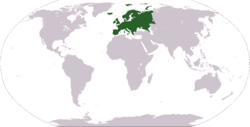
- Europe (continent)
Declension
Related terms
- europietis m, europietė f
This Lithuanian entry was created from the translations listed at Europe. It may be less reliable than other entries, and may be missing parts of speech or additional senses. Please also see Europa in the Lithuanian Wiktionary. This notice will be removed when the entry is checked. (more information) July 2010
Norwegian Bokmål
Etymology
From Latin Europa, from Ancient Greek Εὐρώπη (Eurṓpē).
Proper noun
Europa
- Europe (continent)
- Hun kan alle hovedstedene i Europa.
- She can name all the capitals in Europe.
- Hun kan alle hovedstedene i Europa.
Derived terms
|
|
Related terms
See also
- (continents) kontinent; Afrika, Antarktis, Asia, Australia, Europa, Nord-Amerika, Sør-Amerika
References
- “Europa” in The Ordnett Dictionary
- Online Etymology Dictionary entry on "European"
Norwegian Nynorsk
Etymology
From Latin Europa, from Ancient Greek Εὐρώπη (Eurṓpē).
Proper noun
Europa
- Europe (continent)
- Ho kan alle hovudstadene i Europa.
- She can name all the capitals in Europe.
- Ho kan alle hovudstadene i Europa.
Derived terms
- Aust-Europa
- europakart
- europameister
- Europakommisjonen
- Europaparlamentet
- Europarådet
- Nord-Europa
- Sentral-Europa
- Vest-Europa
Related terms
Novial
Pronunciation
- IPA(key): /euˈro.pa/
Proper noun
Europa
Polish
Pronunciation
- IPA(key): /ɛˈwrɔ.pa/
-
audio (file)
Proper noun
Europa f
Declension
| singular | |
|---|---|
| nominative | Europa |
| genitive | Europy |
| dative | Europie |
| accusative | Europę |
| instrumental | Europą |
| locative | Europie |
| vocative | Europo |
Derived terms
Further reading
- Europa in Polish dictionaries at PWN
Portuguese
Pronunciation
- (Brazil) IPA(key): /ew.ˈɾɔ.pɐ/
Proper noun
Europa f
- Europe (a continent)
- (Greek mythology) Europa (Phoenician princess)
- (astronomy) Europa (moon of Jupiter)
Quotations
For quotations of use of this term, see Citations:Europa.
Related terms
Romanian
Pronunciation
- IPA(key): /e.uˈro.pa/
Proper noun
Europa f
Declension
| singular | ||
|---|---|---|
| f gender | indefinite articulation | definite articulation |
| nominative/accusative | (o) Europă | Europa |
| genitive/dative | (unei) Europe | Europei |
| vocative | Europă, Europo | |
Related terms
Romansch
Etymology
From Latin Eurōpa, from Ancient Greek Εὐρώπη (Eurṓpē).
Proper noun
L'Europa f
Serbo-Croatian
Alternative forms
- Evrópa (Bosnian, Serbian)
Pronunciation
- IPA(key): /eurǒːpa/
- Hyphenation: E‧u‧ro‧pa
Proper noun
Európa f (Cyrillic spelling Еуро́па)
Declension
| singular | |
|---|---|
| nominative | Europa |
| genitive | Europe |
| dative | Europi |
| accusative | Europu |
| vocative | Europo |
| locative | Europi |
| instrumental | Europom |
Spanish
Proper noun
Europa f
- Europe
- (astronomy) Europa (large moon of Jupiter)
- (astronomy) Europa (asteroid)
- (Greek mythology) Europa (woman seduced by Zeus)
Related terms
See also
- (continents) continente; África, América, Antártida, Asia, Oceanía, Europa, Norteamérica/América del Norte, Sudamérica/Suramérica/América del Sur
Swedish
Pronunciation
- IPA(key): /ɛˈruːpa/
Proper noun 1
Europa n (genitive Europas)
Related terms
Proper noun 2
Europa c (genitive Europas)