薙刀
Japanese
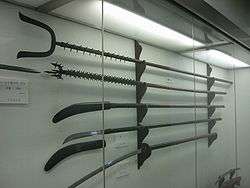
薙刀: various Japanese polearms; the bottom three are kinds of naginata.
| Kanji in this term | |
|---|---|
| 薙 | 刀 |
| なぎ Jinmeiyō |
なた Grade: 2 |
| kun’yomi | |
Alternative forms
Etymology
Compound of 薙ぎ (nagi, the 連用形 (ren'yōkei, “stem form”) of verb 薙ぐ nagu “to mow, to cut down”) + 鉈 (nata, “hatchet”). The use of the 刀 kanji is semantic ateji.
Pronunciation
Noun
薙刀 (hiragana なぎなた, rōmaji naginata)
- (weaponry) a traditional Japanese glaive: a polearm historically used to cut down infantry and cavalry
Derived terms
Derived terms
- 薙刀会釈, 薙刀応答 (なぎなたあしらい, naginata ashirai): keeping at a distance, keeping at arm's length
- 薙刀競技 (なぎなたきょうぎ, naginata kyōgi): a naginata competition, traditionally a sporting event for women
- 薙刀香薷 (なぎなたこうじゅ, naginata kōju): the Vietnamese balm plant, Elsholtzia ciliata
- 薙刀草履 (なぎなたぞうり, naginata zōri): grass or straw sandals with upturned toes
- 薙刀遣い (なぎなたつかい, naginata tsukai): usage of a naginata; a skilled user of a naginata
- 薙刀直し (なぎなたなおし, naginata naoshi): a naginata with a handle cut short, used as a hand weapon
- 薙刀酸漿 (なぎなたほおずき, naginata hōzuki): the egg sac of the veined rapa whelk sea snail, Rapana venosa
References
This article is issued from
Wiktionary.
The text is licensed under Creative Commons - Attribution - Sharealike.
Additional terms may apply for the media files.