薔薇
Chinese
| wild rose | |||
|---|---|---|---|
| trad. (薔薇) | 薔 | 薇 | |
| simp. (蔷薇) | 蔷 | 薇 | |
Pronunciation
Noun
薔薇
Derived terms
|
|
Descendants
See also
- 玫瑰 (méigui)
Japanese
Etymology 1
| Kanji in this term | |
|---|---|
| 薔 | 薇 |
| Hyōgaiji | Hyōgaiji |
| Irregular | |
From 茨 (ibara, “bramble, briar”), itself an alteration from earlier reading ubara of the same meaning. The reading mubara appears in Heian period sources, but ubara is older.[1]
The kanji is jukujikun (熟字訓), from Chinese 薔薇.
Pronunciation
Alternative forms
Noun
薔薇 (hiragana ばら, katakana バラ, rōmaji bara)
Usage notes
As with many terms that name organisms, this term is often spelled in katakana, especially in biological contexts, as バラ.
Derived terms
- 薔薇園 (baraen)
Etymology 2
| Kanji in this term | |
|---|---|
| 薔 | 薇 |
| しょう Hyōgaiji |
び Hyōgaiji |
| on’yomi | |
/sʲaubi/ → /ɕʲɔːbi/ → /ɕoːbi/
From Middle Chinese 薔薇 (MC d͡zɨɐŋ|ʃɨk̚ mˠiɪ|mʉi, literally “wild rose + kind of fern”).
Pronunciation
Noun
薔薇 (hiragana しょうび, rōmaji shōbi, historical hiragana しやうび)
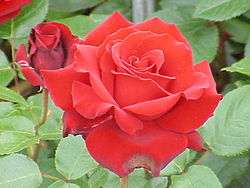
- a thorny flower of the genus Rosa: a rose
- a color scheme for 襲 (kasane, literally “layering”, a traditional style of layering robes or kimono), with crimson for the outer layer and purple for the inner layer
Usage notes
For the rose sense, the bara reading above is most common.
Etymology 3
| Kanji in this term | |
|---|---|
| 薔 | 薇 |
| そう Hyōgaiji |
び Hyōgaiji |
| on’yomi | |
/saubi/ → /sɔːbi/ → /soːbi/
Uses the goon reading of sō for the first character, and the kan'on reading of bi for the second character. Appears to be a shift in reading from shōbi above.[4]
Pronunciation
Noun
薔薇 (hiragana そうび, rōmaji sōbi, historical hiragana さうび)
- a thorny flower of the genus Rosa: a rose
- a color scheme for 襲 (kasane, literally “layering”, a traditional style of layering robes or kimono), with crimson for the outer layer and purple for the inner layer
Usage notes
For the rose sense, the bara reading above is most common.
References
- ↑ 1988, 国語大辞典(新装版) (Kokugo Dai Jiten, Revised Edition) (in Japanese), Tōkyō: Shogakukan
- 1 2 3 2006, 大辞林 (Daijirin), Third Edition (in Japanese), Tōkyō: Sanseidō, →ISBN
- ↑ 1998, NHK日本語発音アクセント辞典 (NHK Japanese Pronunciation Accent Dictionary) (in Japanese), Tōkyō: NHK, →ISBN
- 1 2 3 1997, 新明解国語辞典 (Shin Meikai Kokugo Jiten), Fifth Edition (in Japanese), Tōkyō: Sanseidō, →ISBN
Korean
| Hanja in this term | |
|---|---|
| 薔 | 薇 |
Noun
薔薇 • (jangmi) (hangeul 장미)