芸子
Japanese
| Kanji in this term | |
|---|---|
| 芸 | 子 |
| げい Grade: 4 |
こ Grade: 1 |
| jūbakoyomi | |
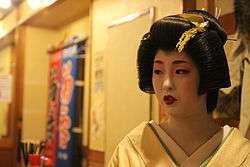
芸子 (geiko): a geiko or geisha in Kyoto.
Etymology
Compound of 芸 (gei, “art, arts, especially performing arts”) + 子 (ko, “child, small thing, junior”).
Pronunciation
Noun
芸子 (hiragana げいこ, rōmaji geiko)
- a geisha, especially a young geisha
- a young kabuki actor, especially one still in training
- a talented person, especially with regard to performing
- short for 芸子髷 (geiko mage): a special kind of hairstyle traditionally worn by geisha
Usage notes
For the sense of a woman employed to wear traditional dress and entertain using traditional song, dance, music, and storytelling:[2]
- geisha is the most general term.
- geigi is most often used in writing, typically more formal writing.
- geiko is more common in the Kansai region of Japan.
- kirei-dokoro can be used to mean a beautifully dressed woman, but more often refers to a woman working as an entertainer in a red-light district.
- hidarizuma is a somewhat old-fashioned epithet for a geisha, referring to the way that geisha hold onto the left (hidari) edge below the collar portion (tsuma) of their kimono while walking.
Synonyms
References
This article is issued from
Wiktionary.
The text is licensed under Creative Commons - Attribution - Sharealike.
Additional terms may apply for the media files.