竹刀
Japanese
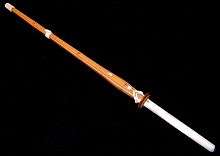
A shinai (竹刀)
Etymology 1
| Kanji in this term | |
|---|---|
| 竹 | 刀 |
| Grade: 1 | Grade: 2 |
| Irregular | |
Originally a clipping of 撓い竹 (shinaidake)[1]: 撓い (shinai, the 連用形 (ren'yōkei, “stem or continuative form”) of 撓う (shinau, “to bend”)) + 竹 (take, “bamboo”).
The kanji are an example of jukujikun (熟字訓).
Pronunciation
Noun
竹刀 (hiragana しない, rōmaji shinai, historical hiragana しなひ)
Descendants
- → English: shinai
Etymology 2
| Kanji in this term | |
|---|---|
| 竹 | 刀 |
| たけ Grade: 1 |
かたな > がたな Grade: 2 |
| kun’yomi | |
Compound of 竹 (take, “bamboo”) + 刀 (katana, “katana”). The katana of 刀 changes to gatana as an instance of rendaku (連濁).
Pronunciation
Noun
竹刀 (hiragana たけがたな, rōmaji takegatana)
Synonyms
- (sword): 竹光 (takemitsu)
Etymology 3
| Kanji in this term | |
|---|---|
| 竹 | 刀 |
| ちく Grade: 1 |
とう Grade: 2 |
| on’yomi | |
From the on'yomi reading of the kanji. (Can this(+) etymology be sourced?)
Pronunciation
Noun
竹刀 (hiragana ちくとう, rōmaji chikutō, historical hiragana ちくたう)
References
This article is issued from
Wiktionary.
The text is licensed under Creative Commons - Attribution - Sharealike.
Additional terms may apply for the media files.