神木
Chinese
God; unusual; mysterious; soul; spirit; divine essence; lively; spiritual being |
tree; wood | ||
|---|---|---|---|
| simp. and trad. (神木) |
神 | 木 | |
Pronunciation
Noun
神木
Proper noun
神木
- (~縣) Shenmu County (county in Shaanxi province, China)
Japanese
Etymology 1
| Kanji in this term | |
|---|---|
| 神 | 木 |
| しん Grade: 3 |
ぼく Grade: 1 |
| on’yomi | |
Possibly from Middle Chinese 神木 (MC ʑiɪn muk̚, literally “god + tree”). Compare modern Min Nan reading sîn-bo̍k. The Japanese term uses the kan'on, suggesting a later borrowing.
Alternatively, may have been coined in Japan as a compound of Middle Chinese-derived elements, as 神 (shin, “god, spirit”) + 木 (boku, “tree”).
Pronunciation
Noun
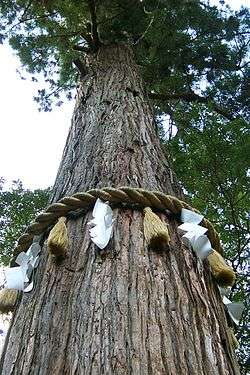
神木 (hiragana しんぼく, rōmaji shinboku)
Synonyms
Etymology 2
| Kanji in this term | |
|---|---|
| 神 | 木 |
| かむ > かん Grade: 3 |
き Grade: 1 |
| kun’yomi | |
/kamuki/ → /kaɴki/
From Old Japanese. Originally a compound of 神 (kamu, “god, spirit”, ancient combining reading) + 木 (ki, “tree”).[2] Appears with the older kamuki phonetic rendering in the Man'yōshū poetry compilation completed in 759 CE.
Pronunciation
Noun
神木 (hiragana かんき, rōmaji kanki)
- (obsolete) see shinboku above
Usage notes
Superseded by the shinboku reading above.
Etymology 3
| Kanji in this term | |
|---|---|
| 神 | 木 |
| さか Grade: 3 |
き Grade: 1 |
| Irregular | |
Alternative spelling of 榊 (sakaki) as jukujikun (熟字訓), likely based on a partial decomposition of the 榊 character into its 神 and 木 components.
Pronunciation
Noun
神木 (hiragana さかき, rōmaji sakaki)
- (rare) the sakaki tree, Cleyera japonica