牡蠣
See also: 牡蛎
Chinese
| male | oyster | ||
|---|---|---|---|
| trad. (牡蠣) | 牡 | 蠣 | |
| simp. (牡蛎) | 牡 | 蛎 | |
Pronunciation
Noun
牡蠣
Synonyms
| Dialectal synonyms of 牡蠣 (“oyster”) [map] | ||
|---|---|---|
| Variety | Location | Words |
| Classical Chinese | 蠣、蠔、牡蠣、牡蛤、蠣蛤、古賁 | |
| Formal (Written Standard Chinese) | 牡蠣 | |
| Taxonomic name | 牡蠣 | |
| Mandarin | Beijing | 牡蠣 |
| Taiwan | 牡蠣、蚵仔、蚵 | |
| Muping | 海蠣子 | |
| Cantonese | Guangzhou | 蠔 |
| Hong Kong | 蠔 | |
| Dongguan | 蠔 | |
| Hakka | Miaoli (N. Sixian) | 蚵仔 |
| Liudui (S. Sixian) | 蚵仔 | |
| Hsinchu (Hailu) | 蚵仔 | |
| Dongshi (Dabu) | 蚵 | |
| Zhuolan (Raoping) | 蚵仔 | |
| Yunlin (Zhao'an) | 蚵 | |
| Min Dong | Fuzhou | 蠣 |
| Fuqing | 蠣 | |
| Matsu | 蠣 | |
| Min Nan | Xiamen | 蚵仔、蚵 |
| Quanzhou | 蚵仔、蚵 | |
| Zhangzhou | 蚵仔、蚵 | |
| Taipei | 蚵仔 | |
| Kaohsiung | 蚵仔 | |
| Tainan | 蚵仔 | |
| Taichung | 蚵仔 | |
| Hsinchu | 蚵仔 | |
| Lukang | 蚵仔 | |
| Sanxia | 蚵 | |
| Yilan | 蚵仔 | |
| Kinmen | 蚵 | |
| Magong | 蚵 | |
| Penang | 蚵 | |
| Philippines (Manila) | 蚵仔 | |
| Chaozhou | 蠔 | |
| Haifeng | 蠔 | |
| Leizhou | 蠔 | |
| Puxian Min | Putian | 蚮 |
| Xianyou | 蚮、蠔 | |
| Wu | Wenzhou | 蠣膏 |
| Ningbo | 蠣黃 | |
Derived terms
|
Japanese
| Kanji in this term | |
|---|---|
| 牡 | 蠣 |
| Jinmeiyō | Hyōgaiji |
| Irregular | |
Etymology
Probably a shift from either:
- 掻き (kaki, “scratching, scraping”), the 連用形 (ren'yōkei, “continuative or stem form”) of verb 掻く (kaku, “to scratch, to scrape”), from the way that oysters are harvested by scraping them off of the oyster bed
- 欠き (kaki, “breaking, chipping”), the 連用形 (ren'yōkei, “continuative or stem form”) of verb 欠く (kaku, “to break, to chip”), from the way that one must break or chip an oyster shell to get at the meat
The spelling is from Chinese 牡蠣, as an example of jukujikun (熟字訓).
Pronunciation
Noun
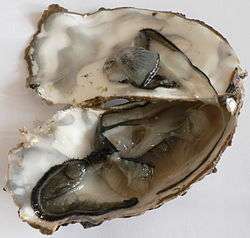
牡蠣 (kyūjitai kanji, shinjitai kanji 牡蛎, hiragana かき, katakana カキ, rōmaji kaki)
- oyster (edible)
Usage notes
As with many terms that name organisms, this term is often spelled in katakana, especially in biological contexts, as カキ.
See also
- 真珠貝 (shinjugai, “pearl oyster”) (inedible)
References
Further reading
- Etymology entry for 牡蠣 at Gogen Jiten (Etymology Dictionary; in Japanese): http://gogen-allguide.com/ka/kaki_kai.html
- Etymology entry for 牡蠣 at Japan Dictionary (in Japanese): http://www.nihonjiten.com/data/45551.html
This article is issued from
Wiktionary.
The text is licensed under Creative Commons - Attribution - Sharealike.
Additional terms may apply for the media files.