照る照る坊主
Japanese
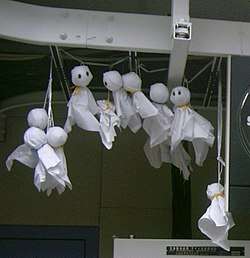
照る照る坊主 (teru teru bōzu): Examples of this rural folk amulet.
| Kanji in this term | |||
|---|---|---|---|
| 照 | 照 | 坊 | 主 |
| て Grade: 4 |
て Grade: 4 |
ぼう Grade: S |
す > ず Grade: 3 |
Alternative forms
Etymology
A phrase, composed of 照る (teru, “to shine, to be sunny”) + 坊主 (bōzu, “Buddhist monk”). Literally, “shine, shine monk”, whereby “shine” is partially in reference to fair weather.
Pronunciation
Noun
照る照る坊主 (hiragana てるてるぼうず, rōmaji teru teru bōzu, historical hiragana てるてるばうず)
Usage notes
Japanese farmers began hanging these outside of their windows on a string. This folk amulet is supposed to have magical powers to bring good weather, and to stop or prevent a rainy day.
References
This article is issued from
Wiktionary.
The text is licensed under Creative Commons - Attribution - Sharealike.
Additional terms may apply for the media files.