明王
Chinese
clear; bright; to understand; next; the Ming dynasty |
king; Wang (proper name) | ||
|---|---|---|---|
| simp. and trad. (明王) |
明 | 王 | |
Etymology
From Sanskrit विद्याराज (vidyārāja, “knowledge king”)
Pronunciation
Noun
明王
- (literary, honorific) enlightened sage (referring to the monarch)
Related terms
- 明妃
Descendants
Japanese
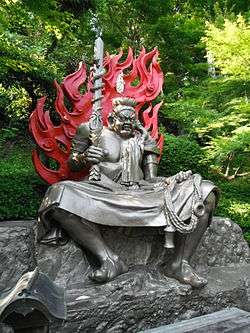
明王 (myōō): a statue of a Wisdom King, specifically Fudō Myōō.
| Kanji in this term | |
|---|---|
| 明 | 王 |
| みょう Grade: 2 |
おう Grade: 1 |
| on’yomi | |
Etymology
Buddhist term, imported into Japanese when Buddhism was introduced to Japan, some time during the Kofun, Asuka, and Nara periods.
From Middle Chinese 明王 (*miæng *hiuɑng, literally “wisdom king”), itself a translation of Sanskrit विद्याराज (vidyārāja, “knowledge king”).[1]
Pronunciation
Noun
明王 (hiragana みょうおう, rōmaji myōō)
- (religion, Buddhism) a Wisdom King in Vajrayana Buddhism
- Also called a Guardian King.
- (religion, Buddhism) short for 五大明王 (Go Dai Myōō), the Five Wisdom Kings
- (religion, Buddhism) by extension, more specifically refers to 不動明王 (Fudō Myōō), the central figure of the Five Wisdom Kings
- (rare) a wise gentleman
Derived terms
- 五大明王 (ごだいみょうおう, Go Dai Myōō): the Five Wisdom Kings
References
This article is issued from
Wiktionary.
The text is licensed under Creative Commons - Attribution - Sharealike.
Additional terms may apply for the media files.