强
| ||||||||
Translingual
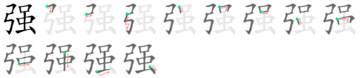
| Stroke order | |||
|---|---|---|---|
 | |||
| Japanese | 強 |
|---|---|
| Simplified | 强 |
| Traditional | 強 |
Glyph origin
Variant of 強.
Han character
强 (radical 57 弓+9, 12 strokes, cangjie input 弓口中戈 (NRLI), composition ⿰弓虽)
Derived characters
References
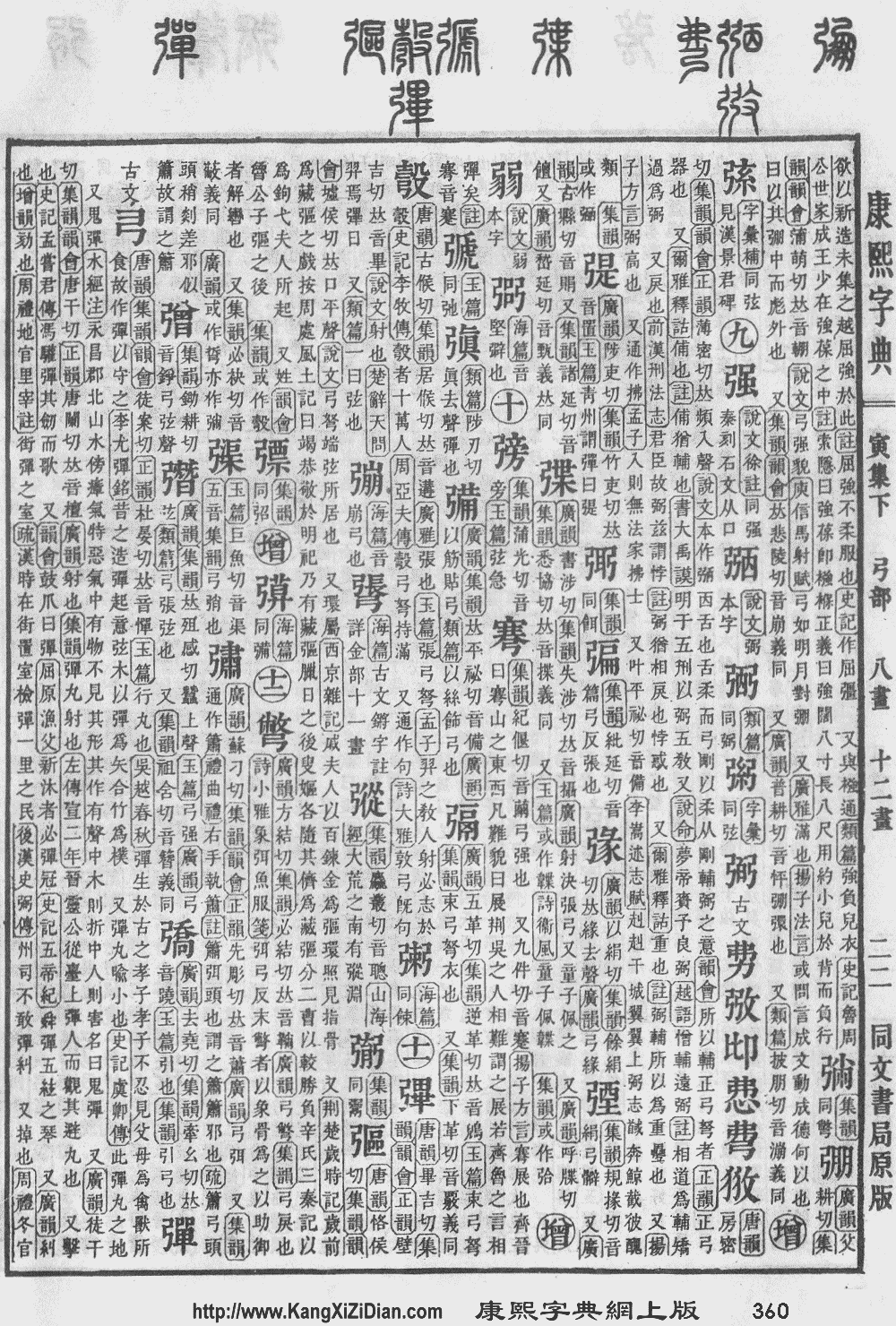
- KangXi: page 360, character 4
- Dai Kanwa Jiten: character 9822
- Dae Jaweon: page 676, character 8
- Hanyu Da Zidian: volume 2, page 999, character 15
- Unihan data for U+5F3A
Chinese
Definitions
| For pronunciation and definitions of 强 – see 強 (“strong; powerful; energetic; to strengthen; etc.”). (This character, 强, is the simplified and variant form of 強.) |
Notes:
|
Usage notes
This character can be found in stone inscriptions dating back to the Qin dynasty
Japanese
Kanji
强
Readings
Usage notes
This character lacks JIS support and is not used in Japan. The character 強 (U+5F37) is used instead.
Korean
Hanja
强 • (gang) (hangeul 강, revised gang, McCune–Reischauer kang, Yale kang)
- This term needs a translation to English. Please help out and add a translation, then remove the text
{{rfdef}}.
Vietnamese
Han character
强 (càng, cường, cưỡng, gượng, ngượng)
- same as cường 強
Compounds
- cường quốc 强國
- cưỡng bức 强逼
- This term needs a translation to English. Please help out and add a translation, then remove the text
{{rfdef}}.
References
- Thiều Chửu : Hán Việt Tự Điển Hà Nội 1942
- Trần Văn Chánh: Từ Điển Hán Việt NXB Trẻ, Ho Chi Minh Ville, 1999
- Vũ Văn Kính: Đại Tự Điển Chữ Nôm, NXB Văn Nghệ, Ho Chi Minh Ville, 1999
- Nom Foundation
This article is issued from
Wiktionary.
The text is licensed under Creative Commons - Attribution - Sharealike.
Additional terms may apply for the media files.