孫の手
Japanese
FWOTD – 23 September 2017
| Kanji in this term | |
|---|---|
| 孫 | 手 |
| まご Grade: 4 |
て Grade: 1 |
| kun’yomi | |
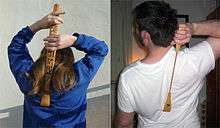
孫の手。
Etymology
From 麻姑 (mako, “Mako, a nymph in Chinese mythology”) + の (no, “'s”) + 手 (te, “hand”), literally “Mako's hand/claw”. Legend has it that Mako's fingernails resembled bird claws.
Compare the following verses in a poem by Tang Dynasty poet Li Bai:
- From: 8th century CE, 李白 (Li Bai), 《西嶽雲台歌送丹丘子》 (A Song of Parting for Dan Qiuzi on Mt Hua's Cloudy Peak)
- Míngxīng yùnǚ bèi sǎsǎo, Mágū sāobèi zhǐzhǎo qīng. [Pinyin]
- The Jade Girl of the bright stars prepares to sprinkle and sweep;
Magu scratches her back lightly with claw-like nails.
This term was remodelled by folk etymology into the current form of 孫 (mago, “grandchild”) + の (no, “'s”) + 手 (te, “hand”), i.e. literally “grandchild's hand”.
Pronunciation
Noun
孫の手 (hiragana まごのて, rōmaji mago no te)
- backscratcher
- 2017, 40代になると巻き起こる老化怪奇現象の対処術
- 生まれて初めて、お婆さんが、孫の手を使って背中を掻く気持ちが分かったっす。
- Umarete hajimete, obāsan ga, magonote o tsukatte senaka o kaku kimochi ga wakattassu.
- For the first time in her life, the old lady understood what it feels like to use a backscratcher to scratch her back.
- 生まれて初めて、お婆さんが、孫の手を使って背中を掻く気持ちが分かったっす。
- 2017, 40代になると巻き起こる老化怪奇現象の対処術
Related terms
- 麻姑掻痒 (makosōyō)
- 麻姑を倩うて痒きを搔く (mako o yatoute kayuki o kaku)
Descendants
References
This article is issued from
Wiktionary.
The text is licensed under Creative Commons - Attribution - Sharealike.
Additional terms may apply for the media files.