四眼田雞
Chinese
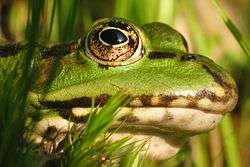
田雞眼
Etymology
Called “four-eyed frog” owing to the belief that wearing glasses causes one's eyes to become protruding (exophthalmic, like a frog's) and dull in appearance.
Pronunciation
- Mandarin
- (Standard Chinese)+
- Pinyin:
- Zhuyin: ㄙˋ ㄧㄢˇ ㄊㄧㄢˊ ㄐㄧ
- Gwoyeu Romatzyh: syhyean tyanji
- IPA (key): /sz̩⁵¹ i̯ɛn²¹⁴⁻²¹¹ tʰi̯ɛn³⁵ t͡ɕi⁵⁵/
- (Standard Chinese, erhua-ed)+
- Pinyin:
- Zhuyin: ㄙˋ ㄧㄢˇㄦ ㄊㄧㄢˊ ㄐㄧ
- Gwoyeu Romatzyh: syhyealtyanji
- IPA (key): /sz̩⁵¹ jɑɻ²¹⁴⁻²¹¹ tʰi̯ɛn³⁵ t͡ɕi⁵⁵/
- (Standard Chinese)+
- Cantonese
- (Standard Cantonese, Guangzhou)+
- Jyutping: sei3 ngaan5 tin4 gai1
- Yale: sei ngáahn tìhn gāi
- Cantonese Pinyin: sei3 ngaan5 tin4 gai1
- Guangdong Romanization: séi3 ngan5 tin4 gei1
- IPA (key): /sei̯³³ ŋɑːn¹³ tʰiːn²¹ kɐi̯⁵⁵/
- (Standard Cantonese, Guangzhou)+
- Wu
- (Shanghainese)
- Wiktionary: sr nge di ji (T2)
- IPA (key): /sz̩³³ ŋe̞⁵⁵ d̻i³³ t͡ɕi²¹/
- (Shanghainese)
Noun
四眼田雞
- (figuratively, colloquial, humorous or pejorative) bespectacled person; someone who wears glasses, especially a young person; four-eyes
This article is issued from
Wiktionary.
The text is licensed under Creative Commons - Attribution - Sharealike.
Additional terms may apply for the media files.