号
See also: 號
| ||||||||
Translingual
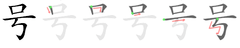
| Stroke order | |||
|---|---|---|---|
 | |||
| Japanese | 号 |
|---|---|
| Simplified | 号 |
| Traditional | 號 |
Han character
号 (radical 30 口+2, 5 strokes, cangjie input 口一女尸 (RMVS), composition ⿱口丂)
References
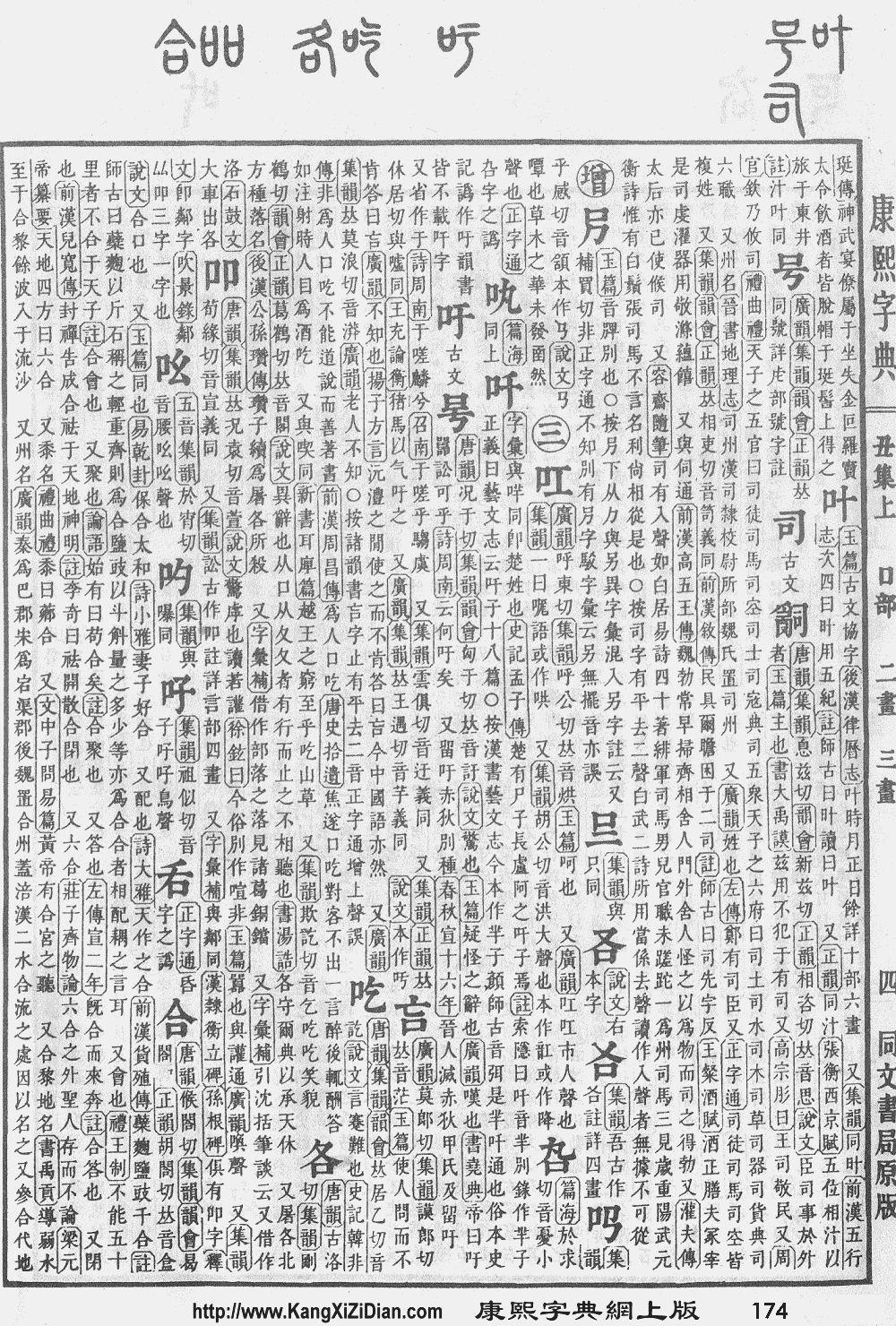
- KangXi: page 174, character 2
- Dai Kanwa Jiten: character 3256
- Dae Jaweon: page 385, character 7
- Hanyu Da Zidian: volume 1, page 570, character 1
- Unihan data for U+53F7
Chinese
Glyph origin
| Characters in the same phonetic series (号) (Zhengzhang, 2003) | |
|---|---|
| Old Chinese | |
| 饕 | *l̥ʰaːw |
| 號 | *ɦlaːw, *ɦlaːws |
| 号 | *ɦlaːws |
| 枵 | *hraw |
| 呺 | *hraw |
| 鴞 | *ɦraw |
Definitions
| For pronunciation and definitions of 号 – see 號 (“name; alias; to order; to command; etc.”). (This character, 号, is the simplified and variant form of 號.) |
Notes:
|
Japanese
| 号 | |
| 號 |
Kanji
号
(grade 3 “Kyōiku” kanji, shinjitai kanji, kyūjitai form 號)
Readings
Compounds
Noun
Suffix
号 (shinjitai kanji, kyūjitai kanji 號, hiragana ごう, rōmaji -gō)
- ordinal marker, often with prefix 第. It's used like -st, -nd, -rd, -th in English.
- (第)六号
- (dai) -roku gō
- (The) 6th
- (第)六号
Korean
Hanja
号 • (ho) (hangeul 호, revised ho, McCune–Reischauer ho)
This article is issued from
Wiktionary.
The text is licensed under Creative Commons - Attribution - Sharealike.
Additional terms may apply for the media files.