هما
Arabic
Pronunciation
Pronoun
هُمَا • (humā) m du, f du
(enclitic form ـهُمَا (-humā) or ـهِمَا (-himā))
- they both, the two of them (masculine or feminine dual subject pronoun)
Suffix
ـهُمَا or ـهِمَا • (-humā or -himā) m du, f du
(enclitic form of هُمَا (humā))
See also
Arabic personal pronouns
| Isolated pronouns | ||||
|---|---|---|---|---|
| singular | dual | plural | ||
| 1st person | أَنَا (ʾanā), إِيَّايَ (ʾiyyāya) | نَحْنُ (naḥnu), إِيَّانَا (ʾiyyānā) | ||
| 2nd person | m | أَنْتَ (ʾanta), إِيَّاكَ (ʾiyyāka) | أَنْتُمَا (ʾantumā), إِيَّاكُمَا (ʾiyyākumā) | أَنْتُمْ (ʾantum), إِيَّاكُم (ʾiyyākum) |
| f | أَنْتِ (ʾanti), إِيَّاكِ (ʾiyyāki) | أَنْتُنَّ (ʾantunna), إِيَّاكُنَّ (ʾiyyākunna) | ||
| 3rd person | m | هُوَ (huwa), إِيَّاهُ (ʾiyyāhu) | هُمَا (humā), إِيَّاهُمَا (ʾiyyāhumā) | هُمْ (hum), إِيَّاهُمْ (ʾiyyāhum) |
| f | هِيَ (hiya), إِيَّاهَا (ʾiyyāhā) | هُنَّ (hunna), إِيَّاهُنَّ (ʾiyyāhunna) | ||
| Enclitic pronouns | ||||
| singular | dual | plural | ||
| 1st person | ـنِي (-nī), ـي (-ī), ـيَ (-ya)* | ـنَا (-nā) | ||
| 2nd person | m | ـكَ (-ka) | ـكُمَا (-kumā) | ـكُم (-kum) |
| f | ـكِ (-ki) | ـكُنَّ (-kunna) | ||
| 3rd person | m | ـهُ (-hu), ـهِ (-hi)** | ـهُمَا (-humā), ـهِمَا (-himā)** | ـهُم (-hum), ـهِم (-him)** |
| f | ـهَا (-hā) | ـهُنَّ (-hunna), ـهِنَّ (-hinna)** | ||
| * Specifically, ـنِي (-nī, “me”) is attached to verbs, but ـي (-ī) or ـيَ (-ya, “my”) is attached to nouns. In the latter case, ـيَ (-ya) is attached to nouns whose construct state ends in a long vowel or diphthong (e.g. in the sound masculine plural and the dual), while ـي (-ī) is attached to nouns whose construct state ends in a short vowel, in which case that vowel is elided (e.g. in the sound feminine plural, as well as the singular and broken plural of most nouns). Furthermore, -ū of the masculine sound plural is assimilated to -ī before ـيَ (-ya) (presumably, -aw of masculine defective -an plurals is similarly assimilated to -ay). Prepositions use ـِي (-ī) or ـيَ (-ya), even though in this case it has the meaning of “me” rather than “my”. The sisters of inna can use either form (e.g. إِنَّنِي (ʾinnanī) or إِنِّي (ʾinnī)), but the longer form (e.g. إِنَّنِي (ʾinnanī)) is usually preferred. ** ـهِـ (-hi-) occurs after -i, -ī, or -ay, and ـهُـ (-hu-) elsewhere (after -a, -ā, -u, -ū, -aw). | ||||
References
- Wehr, Hans (1979), “هما”, in J. Milton Cowan, editor, A Dictionary of Modern Written Arabic, 4th edition, Ithaca, NY: Spoken Language Services, →ISBN
Persian
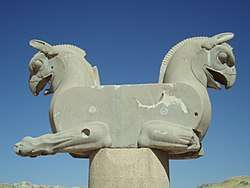
Etymology
From earlier همای (homây), from Middle Persian hwmʾy (humāy).
Noun
هما • (homâ)
Proper noun
هما • (homâ)
- A female given name, Homa.
Tunisian Arabic
Pronoun
هما (humā) pl
This article is issued from
Wiktionary.
The text is licensed under Creative Commons - Attribution - Sharealike.
Additional terms may apply for the media files.