tāss
Latvian
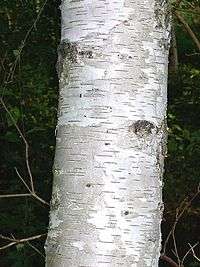
Bērzu tāss
Alternative forms
Etymology
From verb tāst, an archaic and dialectal variant of test, tēst (“to cut, to hew, to trim”); the form follows the pattern of lest, lēst, lāse (compare dialectal forms tāsis, tāse; compare also other dialectal variants above). A comparable synonym term exists in Balto-Finnic languages (e.g., Finnish tuohi) which suggests borrowing between Baltic and Balto-Finnic, but the direction of the borrowing is not clear. Cognates include Lithuanian tóšis.[1]
Pronunciation
- IPA(key): [tāːss]
Noun
tāss f (6th declension)
- birchbark (white bark of the birch tree, formerly used as writing material)
- bērzu tāss ― birch bark
- tāšu iekuri ― birch (bark) kindling
- tāšu darva ― birch (bark) tar
- tāšu taure ― birch (bark) horn
Declension
Declension of tāss (6th declension)
| singular (vienskaitlis) | plural (daudzskaitlis) | |
|---|---|---|
| nominative (nominatīvs) | tāss | tāsis |
| accusative (akuzatīvs) | tāsi | tāsis |
| genitive (ģenitīvs) | tāss | tāšu |
| dative (datīvs) | tāsij | tāsīm |
| instrumental (instrumentālis) | tāsi | tāsīm |
| locative (lokatīvs) | tāsī | tāsīs |
| vocative (vokatīvs) | tāss | tāsis |
See also
References
- ↑ Karulis, Konstantīns (1992), “tāss”, in Latviešu Etimoloģijas Vārdnīca (in Latvian), Rīga: AVOTS, →ISBN
This article is issued from
Wiktionary.
The text is licensed under Creative Commons - Attribution - Sharealike.
Additional terms may apply for the media files.