stilt
English
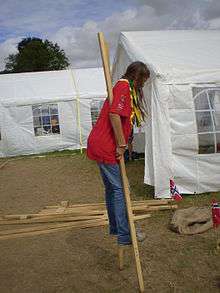
Stilts (walking poles).
Etymology
From Middle English stilte, stulte, from Old English *stilte, *stylte, from Proto-Germanic *stiltijǭ, *staltijǭ, *stultijǭ (“stilt”), from Proto-Germanic *stelt- (“to be stiff”). Akin to Danish stylte, Dutch stelt, German Stelze.
Pronunciation
- Rhymes: -ɪlt
Noun
stilt (plural stilts)
- Either of two poles with footrests that allow someone to stand or walk above the ground; used mostly by entertainers.
- A tall pillar or post used to support some structure; often above water.
- Any of various wading birds of the genera Himantopus and Cladorhynchus, related to the avocet, that have extremely long legs and long thin bills.
- A crutch.
- The handle of a plough.
- (Can we find and add a quotation of Halliwell to this entry?)
Derived terms
Translations
walking pole
|
pillar
bird
crutch — see crutch
Verb
stilt (third-person singular simple present stilts, present participle stilting, simple past and past participle stilted)
- to raise on stilts, or as if on stilts
Anagrams
Norwegian Bokmål
Alternative forms
- stillet (Etymology 3)
Verb
stilt
- past participle of stille
Norwegian Nynorsk
Verb
stilt
- past participle of stilla
Adjective
stilt
- neuter singular of still
This article is issued from
Wiktionary.
The text is licensed under Creative Commons - Attribution - Sharealike.
Additional terms may apply for the media files.