slide
English
Etymology
From Middle English sliden, from Old English slīdan (“to slide”), from Proto-Germanic *slīdaną (“to slide, glide”), from Proto-Indo-European *sleydʰ- (“to slip”). Cognate with Old High German slītan (“to slide”) (German schlittern), Middle Low German slīden (“to slide”), Middle Dutch slīden (“to slide”) (Dutch slijderen, frequentative of now obsolete slijden).
Pronunciation
- IPA(key): /slaɪd/
Audio (US) (file) - Rhymes: -aɪd
Verb
slide (third-person singular simple present slides, present participle sliding, simple past slid, past participle slid or (archaic) slidden)
- (ergative) To (cause to) move in continuous contact with a surface
- He slid the boat across the grass.
- The safe slid slowly.
- Snow slides down the side of a mountain.
- (intransitive) To move on a low-friction surface.
- The car slid on the ice.
- (Can we date this quote?), Waller:
- They bathe in summer, and in winter slide.
- (intransitive, baseball) To drop down and skid into a base.
- Jones slid into second.
- (intransitive) To lose one’s balance on a slippery surface.
- He slid while going around the corner.
- (transitive) To pass or put imperceptibly; to slip.
- to slide in a word to vary the sense of a question
- (intransitive, obsolete) To pass inadvertently.
- Bible, Eccles. xxviii. 26
- Beware thou slide not by it.
- Bible, Eccles. xxviii. 26
- (intransitive) To pass along smoothly or unobservedly; to move gently onward without friction or hindrance.
- A ship or boat slides through the water.
- (Can we date this quote?), Dryden:
- Ages shall slide away without perceiving.
- (Can we date this quote?), Alexander Pope:
- Parts answering parts shall slide into a whole.
- (music) To pass from one note to another with no perceptible cessation of sound.
- To pass out of one's thought as not being of any consequence.
- (Can we date this quote?), Chaucer:
- With good hope let he sorrow slide.
- (Can we date this quote?), Philip Sidney:
- With a calm carelessness letting everything slide.
- (Can we date this quote?), Chaucer:
Derived terms
Translations
to cause to move in contact with a surface
to move in continuous contact with a surface
|
to move with low friction
to lose balance
|
- The translations below need to be checked and inserted above into the appropriate translation tables, removing any numbers. Numbers do not necessarily match those in definitions. See instructions at Wiktionary:Entry layout#Translations.
Translations to be checked
|
|
Noun
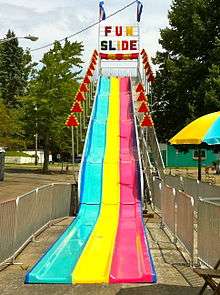
A slide (item of play equipment)
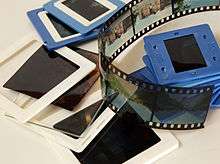
Photographic slide frames for mounting 35 mm film for use in a slide projector
slide (plural slides)
- An item of play equipment that children can climb up and then slide down again.
- The long, red slide was great fun for the kids.
- A surface of ice, snow, butter, etc. on which someone can slide for amusement or as a practical joke.
- (Can we find and add a quotation of Charles Dickens to this entry?)
- The falling of large amounts of rubble, earth and stones down the slope of a hill or mountain; avalanche.
- The slide closed the highway.
- An inclined plane on which heavy bodies slide by the force of gravity, especially one constructed on a mountainside for conveying logs by sliding them down.
- A mechanism consisting of a part which slides on or against a guide.
- The act of sliding; smooth, even passage or progress.
- a slide on the ice
- Francis Bacon
- A better slide into their business.
- A lever that can be moved in two directions.
- A valve that works by sliding, such as in a trombone.
- A transparent plate bearing an image to be projected to a screen.
- (sciences) A flat, usually rectangular piece of glass or similar material on which a prepared sample may be viewed through a microscope Generally referred to as a microscope slide.
- (baseball) The act of dropping down and skidding into a base
- (music, guitar) A hand-held device made of smooth, hard material, used in the practice of slide guitar.
- (traditional Irish music and dance) A lively dance from County Kerry, in 12/8 time.
- (geology) A small dislocation in beds of rock along a line of fissure.
- (Can we find and add a quotation of Dana to this entry?)
- (music) A grace consisting of two or more small notes moving by conjoint degrees, and leading to a principal note either above or below.
- (phonetics) A sound which, by a gradual change in the position of the vocal organs, passes imperceptibly into another sound.
- A clasp or brooch for a belt, etc.
- (footwear) A shoe that is backless and open-toed.
- (speech therapy) A voluntary stutter used as a technique to control stuttering in one's speech.
Synonyms
Derived terms
- landslide
- mudslide
- water slide
- hairslide
- (transparent plate bearing an image): slide projector, slide viewer
Translations
item of play equipment
|
|
rubble, earth and stones moving down
|
|
act of sliding
|
valve in eg. a trombone
transparent image for projecting
|
|
microscope slide
|
|
slide for playing slide guitar
|
|
- The translations below need to be checked and inserted above into the appropriate translation tables, removing any numbers. Numbers do not necessarily match those in definitions. See instructions at Wiktionary:Entry layout#Translations.
Translations to be checked
|
|
Anagrams
Portuguese
Etymology
Pronunciation
- (Brazil) IPA(key): /iz.ˈlaj.d͡ʒi/, /ˈslajd͡ʒ/, /ˈzlajd͡ʒ/, /ˈslajd/
Noun
slide m (plural slides)
- slide (transparent image for projecting)
- Synonyms: transparência, diapositivo
- slide (a frame in a slideshow)
- (music) slide (device for playing slide guitar)
- (music) slide (guitar technique where the player moves finger up or down the fretboard)
This article is issued from
Wiktionary.
The text is licensed under Creative Commons - Attribution - Sharealike.
Additional terms may apply for the media files.