skeleton
English
Pronunciation
audio (GA) (file)
Etymology 1
| Picture dictionary | ||
|---|---|---|
| ||
|
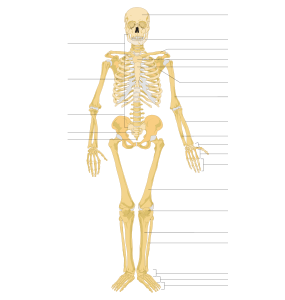

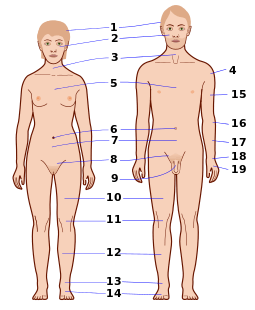
From Ancient Greek σκελετός (skeletós, “dried up, withered, dried body, parched, mummy”), from σκέλλω (skéllō, “dry, dry up, make dry, parch”), from Proto-Indo-European *(s)kelh₁- (“to parch, wither”); compare Greek σκληρός "hard".
Alternative forms
- sceleton (obsolete)
Noun
skeleton (plural skeletons or skeleta)
- (anatomy) The system that provides support to an organism, internal and made up of bones and cartilage in vertebrates, external in some other animals.
- 1881–1882, Robert Louis Stevenson, “The Treasure Hunt—Flint’s Pointer”, in Treasure Island, London; Paris: Cassell & Company, Limited, published 14 November 1883, OCLC 702939134, part VI (Captain Silver), page 263:
- At the foot of a pretty big pine, and involved in a green creeper, which had even partly lifted some of the smaller bones, a human skeleton lay, with a few shreds of clothing, on the ground.
-
- An anthropomorphic representation of a skeleton.
- She dressed up as a skeleton for Halloween.
- 1724, Charles Johnson, “Of Captain Spriggs and His Crew”, in A General History of the Pyrates, from Their First Rise and Settlement in the Island of Providence, to the Present Time. With the Remarkable Actions and Adventures of the Two Female Pyrates Mary Read and Anne Bonny; [...] To which is Added. A Short Abstract of the Statute and Civil Law, in Relation to Pyracy, 2nd edition, London: Printed for, and sold by T. Warner, at the Black-Boy in Pater-Noster-Row, OCLC 2276353, pages 411–412:
- A Day or two after they parted, [Francis] Spriggs was choſe Captain by the reſt, and a black Enſign was made, which they called Jolly Roger, with the ſame Device that Captain [Edward] Low carried, viz. a white Skeliton in the Middle of it, with a Dart in one Hand ſtriking a bleeding Heart, and in the other, an Hour Glaſs; when this was finiſhed and hoiſted, they fired all their Guns to ſalute their Captain and themſelves, and then looked out for Prey.
- (figuratively) A very thin person.
- She lost so much weight while she was ill that she became a skeleton.
- (figuratively) The central core of something that gives shape to the entire structure.
- The skeleton of the organisation is essentially the same as it was ten years ago, but many new faces have come and gone.
- (architecture) A frame that provides support to a building or other construction.
- (computing) A client-helper procedure that communicates with a stub.
- In remote method invocation, the client helper is a ‘stub’ and the service helper is a ‘skeleton’.
- (geometry) The vertices and edges of a polyhedron, taken collectively.
Synonyms
- (anatomy): ottomy (obsolete), skellington (nonstandard)
- (very thin person): see also Thesaurus:thin person
- (central core giving shape to something): backbone
Antonyms
- (computing): stub
Derived terms
Related terms
Terms related to skeleton
|
|
|
Translations
system that provides support to an organism
|
|
very thin person
frame that provides support to a building
|
computing: client-helper procedure
- The translations below need to be checked and inserted above into the appropriate translation tables, removing any numbers. Numbers do not necessarily match those in definitions. See instructions at Wiktionary:Entry layout#Translations.
Verb
skeleton (third-person singular simple present skeletons, present participle skeletoning, simple past and past participle skeletoned)
- (archaic) to reduce to a skeleton; to skin; to skeletonize
- (archaic) to minimize
See also
Etymology 2
The etymology of the term is disputed between two versions.[1]
- From the sled used, which originally was a bare frame, like a skeleton.[1]
- From Norwegian kjaelke (a type of ice sled) through a bad anglicization as "skele".[1]
Noun
skeleton (uncountable)
- (sports, uncountable) A type of tobogganing in which competitors lie face down, and descend head first (compare luge).
Synonyms
- (type of tobogganing): skeleton tobogganing
Translations
type of tobogganing
|
See also
References
- 1 2 3 IBSF (International Bobsleigh & Skeleton Federation), "Skeleton history" (2015)
Further reading

Esperanto
Noun
skeleton
- accusative singular of skeleto
French
Pronunciation
- IPA(key): /ske.le.tɔ̃/
Noun
skeleton m (uncountable)
- skeleton (winter sport)
Derived terms
Portuguese
Noun
skeleton m (uncountable)
- skeleton (type of tobogganing)
Related terms
This article is issued from
Wiktionary.
The text is licensed under Creative Commons - Attribution - Sharealike.
Additional terms may apply for the media files.