shackle
English
Etymology
From Middle English schakkyl, schakle, from Old English sceacel, sceacul, scacul (“shackle, bond, fetter”), from Proto-Germanic *skakulaz (“shackle”), from Proto-Indo-European *skeg-, *skek- (“to jump, move, shake, stir”), equivalent to shake + -le. Cognate with Dutch schakel (“link, shackle, clasp”), German Schäckel (“shackle”), Danish skagle (“a carriage trace”), Swedish skakel (“the loose shaft of a carriage”), Icelandic skökull (“a carriage pole”).
Pronunciation
- Rhymes: -ækəl
Noun
shackle (plural shackles)
- A restraint fit over a human or animal appendage, such as a wrist, ankle or finger. Usually used in plural, to indicate a pair joined by a chain; a hobble.
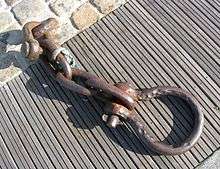
- A U-shaped piece of metal secured with a pin or bolt across the opening, or a hinged metal loop secured with a quick-release locking pin mechanism.
- (figuratively, usually in the plural) A restraint on one's action, activity, or progress.
- South
- His very will seems to be in bonds and shackles.
- South
- A fetter-like band worn as an ornament.
- Dampier
- Most of the men and women […] had all earrings made of gold, and gold shackles about their legs and arms.
- Dampier
- A link for connecting railroad cars; a drawlink or draglink.
- A length of cable or chain equal to 12.5 fathoms or 75 feet, or later to 15 fathoms.
- Stubble.
- (Can we find and add a quotation of Pegge to this entry?)
Hyponyms
Derived terms
Translations
|
See also
- (U-shaped piece): clevis
Verb
shackle (third-person singular simple present shackles, present participle shackling, simple past and past participle shackled)
- To restrain using shackles; to place in shackles.
- By extension, to render immobile or incapable; to inhibit the progress or abilities of someone or something.
- This law would effectively shackle its opposition.
- 2011 February 12, Phil McNulty, “Man Utd 2 - 1 Man City”, in BBC:
- Rooney, superbly shackled by City defender Vincent Kompany for so long as Ferguson surprisingly left Dimitar Berbatov on the bench, had previously cut a forlorn and frustrated figure but his natural instincts continue to serve him and United so well.
Antonyms
Translations
Anagrams
Scots
Etymology
From Old English sceacel, sceacul, scacul (“shackle, bond, fetter”), from Proto-Germanic *skakulaz (“shackle”), from Proto-Indo-European *skeg-, *skek- (“to jump, move, shake, stir”).
Pronunciation
- IPA(key): [ʃakl], [ʃekl]
Noun
shackle (plural shackles)
Derived terms
- shackle-bane (“wrist”)
Verb
shackle (third-person singular present shackles, present participle shacklin, past shackelt, past participle shackelt)
- to shackle