salad
English
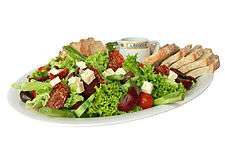
A salad.
Alternative forms
- sallet [16th-19th c.]
Etymology
Borrowed from French salade, borrowed from Northern Italian salada, salata (compare insalata), from Vulgar Latin *salāta, from *salāre, from Latin saliō, from sal (“salt”).
Pronunciation
Noun
salad (countable and uncountable, plural salads)
- A food made primarily of a mixture of raw or cold ingredients, typically vegetables, usually served with a dressing such as vinegar or mayonnaise.
- c. 1602, William Shakespeare, All’s Well That Ends Well, Act IV, Scene 5,
- Lafeu. ’Twas a good lady, ’twas a good lady: we may pick a thousand salads ere we light on such another herb.
- Clown. Indeed, sir, she was the sweet marjoram of the salad, or rather, the herb of grace.
- c. 1602, William Shakespeare, All’s Well That Ends Well, Act IV, Scene 5,
- A raw vegetable of the kind used in salads.
Derived terms
Terms derived from salad
|
Related terms
Translations
food
|
|
Anagrams
Cebuano
Etymology
From English salad, borrowed from French salade, borrowed from Northern Italian salada, salata, from Vulgar Latin *salāta, from *salāre, from Latin saliō, from sal (“salt”).
Pronunciation
- Hyphenation: sa‧lad
Noun
salad
Spanish
Verb
salad
This article is issued from
Wiktionary.
The text is licensed under Creative Commons - Attribution - Sharealike.
Additional terms may apply for the media files.