runa
Bikol Central
Noun
runâ
Gothic
Romanization
rūna
- Romanization of 𐍂𐌿𐌽𐌰
Icelandic
Etymology
Pronunciation
- IPA(key): /ˈrʏːna/
- Rhymes: -ʏːna
Noun
runa f (genitive singular runu, nominative plural runur)
- row, sequence
- Synonym: röð
- string of letters or names, enumeration
- Synonyms: romsa, þula, upptalning
- rigmarole
- Synonyms: romsa, langloka
- (mathematics) series, sequence
Declension
Anagrams
Italian
Etymology
Noun
runa f (plural rune)
Related terms
Anagrams
Latin
Noun
rūna f (genitive rūnae); first declension
Inflection
First declension.
| Case | Singular | Plural |
|---|---|---|
| nominative | rūna | rūnae |
| genitive | rūnae | rūnārum |
| dative | rūnae | rūnīs |
| accusative | rūnam | rūnās |
| ablative | rūnā | rūnīs |
| vocative | rūna | rūnae |
References
- runa in Charlton T. Lewis and Charles Short (1879) A Latin Dictionary, Oxford: Clarendon Press
- runa in Charles du Fresne du Cange’s Glossarium Mediæ et Infimæ Latinitatis (augmented edition, 1883–1887)
- runa in Gaffiot, Félix (1934) Dictionnaire Illustré Latin-Français, Hachette
Latvian
Etymology
From Proto-Indo-European *reu-, *ru-, imitative of speech sounds (from which also Latvian rūkt (“to roar, growl, snarl”), Russian рычать (ryčatʹ, “to roar, growl, snarl”)) with a suffix *-nā. Cognates include Old Irish run, Gothic 𐍂𐌿𐌽𐌰 (rūna, “secret, mystery”) (i.e., that which is said as a secret), Old English rūn, Old Saxon rūna, Middle Low German rūne (“mysterious whisper; runic character”), Old Norse rýna (“to talk secretly”), Old English rūnian (“to whisper; to plot, conspire”), Old High German rūnēn, German raunen (“to whisper”). Latvian runa probably also meant originally “solemn speech” (maybe “mystic ritual”?); still in the 17-19th centuries it was often used to indicate some special kind of communication (e.g., runas dot “to give advice”, lit. “to give talk”, or runas diena “council meeting”, lit. “talking day”).[1]
Noun
runa f (4th declension)
- speech, speaking, talking (articulated production of language)
- runas spēja, iemaņas, traucējumi ― speech ability, skills, disorders
- runas orgāni, aparāts ― speech organs, apparatus
- iekšēja runa ― internal speech, internal monologue
- ātra runa ― fast speech; a quick question
- izteiksmīga runa ― expressive speech
- runas veids ― way, style of speaking
- bērnu runa ― children's talk
- talk, words (what is said by someone)
- par ko ir runa? — what (are you) talking about?
- par to nevar būt ne runas ― about that there can be no talk, it is out of the question
- ticēt glaimu runām ― to believe flattering words
- runas apklusa ― the talking (= people) became silent
- speech (a spoken text, often delivered in public)
- runas māksla ― the art of speech, oratory
- oratora runa ― the speaker's talk
- apsveikuma runa ― welcome speech
- teikt runu, uzstāties ar runu ― to deliver a speech
- publiskā runa ― public speech
- galda runa ― table, banquet speech, after-dinner speech
- (grammar) speech (direct or indirect presentation of someone's words)
- tiešā, netiešā runa ― direct, indirect speech
- (chiefly in the plural) rumor, gossip, idle talk
- tukšas runas ― empty rumors
- kaimiņu runas ― neighbors' talk
- zināt no ļaužu runām ― to know from people's talk, by hearsay
- neklausīties ļaužu runās ― don't listen to people's talk
Declension
Derived terms
References
- ↑ Karulis, Konstantīns (1992), “runāt”, in Latviešu Etimoloģijas Vārdnīca (in Latvian), Rīga: AVOTS, →ISBN
Mapudungun
Noun
runa (using Raguileo Alphabet)
- a handful
References
- Wixaleyiñ: Mapucezugun-wigkazugun pici hemvlcijka (Wixaleyiñ: Small Mapudungun-Spanish dictionary), Beretta, Marta; Cañumil, Dario; Cañumil, Tulio, 2008.
Old English
Pronunciation
- IPA(key): /ˈruːnɑ/
Noun
rūna f
Polish
Etymology
From Old Norse rún (“secret, rune”), from Proto-Norse ᚱᚢᚾᛟ (runo), from Proto-Germanic *rūnō.
Pronunciation
- IPA(key): /ˈruna/
Noun
runa f
Declension
Related terms
Noun
runa
- genitive singular of runo
- nominative plural of runo
- accusative plural of runo
- vocative plural of runo
Portuguese
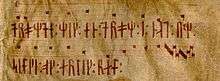
Etymology
From French rune, from Old Norse rún, rúnar (“secret, rune”), from Proto-Germanic *rūnō.
Pronunciation
- (Portugal) IPA(key): /ˈʁu.nɐ/
Noun
runa f (plural runas)
Related terms
Quechua
Noun
runa
Declension
| singular | plural | |
|---|---|---|
| nominative | runa | runakuna |
| accusative | runata | runakunata |
| dative | runaman | runakunaman |
| genitive | runap | runakunap |
| locative | runapi | runakunapi |
| terminative | runakama | runakunakama |
| ablative | runamanta | runakunamanta |
| instrumental | runawan | runakunawan |
| comitative | runantin | runakunantin |
| abessive | runannaq | runakunannaq |
| comparative | runahina | runakunahina |
| causative | runarayku | runakunarayku |
| benefactive | runapaq | runakunapaq |
| associative | runapura | runakunapura |
| distributive | runanka | runakunanka |
| exclusive | runalla | runakunalla |
| ñuqap (my) | singular | plural |
|---|---|---|
| nominative | runay | runaykuna |
| accusative | runayta | runaykunata |
| dative | runayman | runaykunaman |
| genitive | runaypa | runaykunap |
| locative | runaypi | runaykunapi |
| terminative | runaykama | runaykunakama |
| ablative | runaymanta | runaykunamanta |
| instrumental | runaywan | runaykunawan |
| comitative | runaynintin | runaykunantin |
| abessive | runayninnaq | runaykunannaq |
| comparative | runayhina | runaykunahina |
| causative | runayrayku | runaykunarayku |
| benefactive | runaypaq | runaykunapaq |
| associative | runaypura | runaykunapura |
| distributive | runayninka | runaykunanka |
| exclusive | runaylla | runaykunalla |
| qampa (your) | singular | plural |
|---|---|---|
| nominative | runayki | runaykikuna |
| accusative | runaykita | runaykikunata |
| dative | runaykiman | runaykikunaman |
| genitive | runaykipa | runaykikunap |
| locative | runaykipi | runaykikunapi |
| terminative | runaykikama | runaykikunakama |
| ablative | runaykimanta | runaykikunamanta |
| instrumental | runaykiwan | runaykikunawan |
| comitative | runaykintin | runaykikunantin |
| abessive | runaykinnaq | runaykikunannaq |
| comparative | runaykihina | runaykikunahina |
| causative | runaykirayku | runaykikunarayku |
| benefactive | runaykipaq | runaykikunapaq |
| associative | runaykipura | runaykikunapura |
| distributive | runaykinka | runaykikunanka |
| exclusive | runaykilla | runaykikunalla |
| paypa (his/her/its) | singular | plural |
|---|---|---|
| nominative | runan | runankuna |
| accusative | runanta | runankunata |
| dative | runanman | runankunaman |
| genitive | runanpa | runankunap |
| locative | runanpi | runankunapi |
| terminative | runankama | runankunakama |
| ablative | runanmanta | runankunamanta |
| instrumental | runanwan | runankunawan |
| comitative | runanintin | runankunantin |
| abessive | runanninnaq | runankunannaq |
| comparative | runanhina | runankunahina |
| causative | runanrayku | runankunarayku |
| benefactive | runanpaq | runankunapaq |
| associative | runanpura | runankunapura |
| distributive | runaninka | runankunanka |
| exclusive | runanlla | runankunalla |
| ñuqanchikpa (our(incl)) | singular | plural |
|---|---|---|
| nominative | runanchik | runanchikkuna |
| accusative | runanchikta | runanchikkunata |
| dative | runanchikman | runanchikkunaman |
| genitive | runanchikpa | runanchikkunap |
| locative | runanchikpi | runanchikkunapi |
| terminative | runanchikkama | runanchikkunakama |
| ablative | runanchikmanta | runanchikkunamanta |
| instrumental | runanchikwan | runanchikkunawan |
| comitative | runanchiknintin | runanchikkunantin |
| abessive | runanchikninnaq | runanchikkunannaq |
| comparative | runanchikhina | runanchikkunahina |
| causative | runanchikrayku | runanchikkunarayku |
| benefactive | runanchikpaq | runanchikkunapaq |
| associative | runanchikpura | runanchikkunapura |
| distributive | runanchikninka | runanchikkunanka |
| exclusive | runanchiklla | runanchikkunalla |
| ñuqaykup (our(excl)) | singular | plural |
|---|---|---|
| nominative | runayku | runaykukuna |
| accusative | runaykuta | runaykukunata |
| dative | runaykuman | runaykukunaman |
| genitive | runaykupa | runaykukunap |
| locative | runaykupi | runaykukunapi |
| terminative | runaykukama | runaykukunakama |
| ablative | runaykumanta | runaykukunamanta |
| instrumental | runaykuwan | runaykukunawan |
| comitative | runaykuntin | runaykukunantin |
| abessive | runaykunnaq | runaykukunannaq |
| comparative | runaykuhina | runaykukunahina |
| causative | runaykurayku | runaykukunarayku |
| benefactive | runaykupaq | runaykukunapaq |
| associative | runaykupura | runaykukunapura |
| distributive | runaykunka | runaykukunanka |
| exclusive | runaykulla | runaykukunalla |
| qamkunap (your(pl)) | singular | plural |
|---|---|---|
| nominative | runaykichik | runaykichikkuna |
| accusative | runaykichikta | runaykichikkunata |
| dative | runaykichikman | runaykichikkunaman |
| genitive | runaykichikpa | runaykichikkunap |
| locative | runaykichikpi | runaykichikkunapi |
| terminative | runaykichikkama | runaykichikkunakama |
| ablative | runaykichikmanta | runaykichikkunamanta |
| instrumental | runaykichikwan | runaykichikkunawan |
| comitative | runaykichiknintin | runaykichikkunantin |
| abessive | runaykichikninnaq | runaykichikkunannaq |
| comparative | runaykichikhina | runaykichikkunahina |
| causative | runaykichikrayku | runaykichikkunarayku |
| benefactive | runaykichikpaq | runaykichikkunapaq |
| associative | runaykichikpura | runaykichikkunapura |
| distributive | runaykichikninka | runaykichikkunanka |
| exclusive | runaykichiklla | runaykichikkunalla |
| paykunap (their) | singular | plural |
|---|---|---|
| nominative | runanku | runankukuna |
| accusative | runankuta | runankukunata |
| dative | runankuman | runankukunaman |
| genitive | runankupa | runankukunap |
| locative | runankupi | runankukunapi |
| terminative | runankukama | runankukunakama |
| ablative | runankumanta | runankukunamanta |
| instrumental | runankuwan | runankukunawan |
| comitative | runankuntin | runankukunantin |
| abessive | runankunnaq | runankukunannaq |
| comparative | runankuhina | runankukunahina |
| causative | runankurayku | runankukunarayku |
| benefactive | runankupaq | runankukunapaq |
| associative | runankupura | runankukunapura |
| distributive | runankunka | runankukunanka |
| exclusive | runankulla | runankukunalla |
Descendants
- → Spanish: runa
Serbo-Croatian
Pronunciation
- IPA(key): /rûːna/
- Hyphenation: ru‧na
Noun
rȗna f (Cyrillic spelling ру̑на)
Declension
References
- “runa” in Hrvatski jezični portal
Slovak
Etymology
From Old Norse rún, rúnar (“secret, rune”), from Proto-Norse ᚱᚢᚾᛟ (runo), from Proto-Germanic *rūnō.
Pronunciation
- IPA(key): /ˈru.na/
- Hyphenation: ru‧na
Noun
runa f (genitive singular runy, nominative plural runy, genitive plural rún, declension pattern of žena)
Declension
Derived terms
- runový
References
- runa in Slovak dictionaries at korpus.sk
Spanish
Pronunciation
- IPA(key): /ˈru.na/
Etymology 1
Borrowed from Old Norse rún, rúnar (“secret, rune”), from Proto-Germanic *rūnō.
Noun
runa f (plural runas)
Derived terms
Etymology 2
Borrowed from Quechua runa (“man”).
Noun
runa m (plural runas)
- (colloquial, in Quechua communities) man
Etymology 3
Adjective
runa
- Feminine singular of adjective runo.
Swedish
Etymology
From Old Swedish run, from Old Norse rún, from Proto-Norse ᚱᚢᚾᛟ (runo), from Proto-Germanic *rūnō.
Noun
runa c
Declension
| Declension of runa | ||||
|---|---|---|---|---|
| Singular | Plural | |||
| Indefinite | Definite | Indefinite | Definite | |
| Nominative | runa | runan | runor | runorna |
| Genitive | runas | runans | runors | runornas |
Related terms
|
|
|
|