retina
English
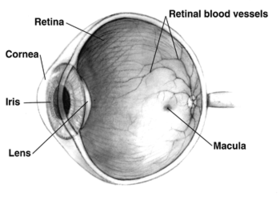
Etymology
From Medieval Latin retina, the diminutive form of Latin rete (“net”), probably from the Vulgar Latin phrase (tunica) *retina, literally "net-like tunic", used to describe the blood vessel system at the back of the eye. (Gerard of Cremona may have created this phrase as a translation for Arabic (ṭabaqa) shabakiyya "net-like layer", which translates Ancient Greek ἀμφιβληστροειδής (amphiblēstroeidḗs) (χιτών (khitṓn))).[1]
Pronunciation
- (US) IPA(key): /ˈɹɛt.ɨ.nə/
Noun
retina (plural retinas or retinae or retinæ)
- (anatomy) The thin layer of cells at the back of the eyeball where light is converted into neural signals sent to the brain.
Derived terms
Translations
|
|
References
Further reading

Anagrams
Catalan
Noun
retina m (plural retines)
Dutch
Etymology
From Medieval Latin rētina, the diminutive form of Latin rēte (“net”), probably from Vulgar Latin tunica *retina (literally “net-like tunic”), used to describe the blood vessel system at the back of the eye.
Pronunciation
Audio (file) - Hyphenation: re‧ti‧na
Noun
retina f, m (plural retina's, diminutive retinaatje n)
Anagrams
Hungarian
Noun
retina
Italian
Etymology 1
The original sense (Etymology 2) of retina, but given a specific anatomical meaning.
Pronunciation
- IPA(key): /ˈrɛtina/
- Hyphenation: rè‧ti‧na
Noun
retina f (plural retine)
Derived terms
Etymology 2
Pronunciation
- IPA(key): /reˈtina/
- Hyphenation: re‧tì‧na
Noun
Verb
retina
Anagrams
Latin
Etymology 1
An abbreviation of the Classical retināculum n, which, because it occurred almost exclusively in the plural (retinācula, -ōrum), was reinterpreted in its abbreviated form as a feminine, rather than a neuter, noun.
Pronunciation
- (Classical) IPA(key): /ˈre.ti.na/, [ˈrɛ.tɪ.na]
Noun
retina f (genitive retinae); first declension
- (Medieval Latin) a rein (strap or rope attached to a bridle or bit, used to control an animal)
Declension
First declension.
| Case | Singular | Plural |
|---|---|---|
| nominative | retina | retinae |
| genitive | retinae | retinārum |
| dative | retinae | retinīs |
| accusative | retinam | retinās |
| ablative | retinā | retinīs |
| vocative | retina | retinae |
References
- 2. RETINA in Charles du Fresne du Cange’s Glossarium Mediæ et Infimæ Latinitatis (augmented edition, 1883–1887)
Etymology 2
An etymologising spelling, closer to the word’s etymon, the Ancient Greek ῥητῑ́νη (rhētī́nē).
Pronunciation
- (Classical) IPA(key): /reːˈtiː.na/
Noun
rētīna f (genitive rētīnae); first declension
- medieval spelling of rēsīna (“resin”)
Declension
First declension.
| Case | Singular | Plural |
|---|---|---|
| nominative | rētīna | rētīnae |
| genitive | rētīnae | rētīnārum |
| dative | rētīnae | rētīnīs |
| accusative | rētīnam | rētīnās |
| ablative | rētīnā | rētīnīs |
| vocative | rētīna | rētīnae |
References
- 1. RETINA in Charles du Fresne du Cange’s Glossarium Mediæ et Infimæ Latinitatis (augmented edition, 1883–1887)
Portuguese
Verb
retina
- first-person singular present subjunctive of retinir
- third-person singular present subjunctive of retinir
- third-person singular imperative of retinir
Spanish
Pronunciation
- IPA(key): /reˈtina/, [reˈt̪ina]
Noun
retina f (plural retinas)