rasa
English
Etymology
Borrowed from Sanskrit रस (rása, literally “juice; essence”).
Noun
rasa (plural rasas)
Derived terms
Anagrams
Czech
Etymology
Borrowed from German Rasse, from French race, from Italian razza, possibly from Arabic رَأْس (raʾs, “head”).
Noun
rasa f
- race (group of people)
Declension
Related terms
Esperanto
Etymology
Adjective
rasa (accusative singular rasan, plural rasaj, accusative plural rasajn)
Related terms
French
Verb
rasa
- third-person singular past historic of raser
Anagrams
Indonesian
Etymology
Pronunciation
- IPA(key): /ra.sa/
Noun
rasa
Italian
Adjective
rasa f sg
- Feminine singular of adjective raso.
Verb
rasa
Anagrams
Latin
Participle
rāsa
- nominative feminine singular of rāsus
- nominative neuter plural of rāsus
- accusative neuter plural of rāsus
- vocative feminine singular of rāsus
- vocative neuter plural of rāsus
rāsā
- ablative feminine singular of rāsus
Latvian
Etymology
From Proto-Balto-Slavic *rasāˀ, from Proto-Indo-European *Hróseh₂. Cognates include Lithuanian rasà, Old Church Slavonic роса (rosa), Russian, Ukrainian, Belarusian, Bulgarian роса (rosa), Upper Sorbian, Czech, Polish rosa, Sanskrit रस (rása, “juice, liquid”), रसा (rásā, “moisture, humidity”), Latin rōs.[1]
Noun
rasa f (4th declension)
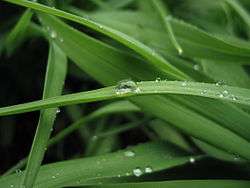
- dew (moisture in the air that settles on plants in the morning)
- rīta rasa ― morning dew
- rasas lāses ― dew drops
- sasalusi rasa ― frozen dew
- samērcēt kājas rasā ― to soak one's feet in dew
- very light rain, drizzle
- viegla rasas migla nokārās pār visu ciemu ― a light drizzle lowered its mist over the whole village
- tiny, dew-like drops
- pierē drīz jau iemetās pirmā sviedru rasa ― on (his) forehead the first drops of sweat will soon appear
Declension
| singular (vienskaitlis) | plural (daudzskaitlis) | |
|---|---|---|
| nominative (nominatīvs) | rasa | — |
| accusative (akuzatīvs) | rasu | — |
| genitive (ģenitīvs) | rasas | — |
| dative (datīvs) | rasai | — |
| instrumental (instrumentālis) | rasu | — |
| locative (lokatīvs) | rasā | — |
| vocative (vokatīvs) | rasa | — |
Derived terms
References
- ↑ Karulis, Konstantīns (1992), “rasa”, in Latviešu Etimoloģijas Vārdnīca (in Latvian), Rīga: AVOTS, →ISBN
Lithuanian
Etymology
From Proto-Balto-Slavic *rasā́ˀ, from Proto-Indo-European *Hróseh₂.
Noun
rasa f
Malay
Etymology 1
Noun
rasa (plural rasa-rasa)
Etymology 2
Noun
rasa (plural rasa-rasa)
- Alternative form of raksa (“quicksilver”)
Polish
Etymology
Borrowed from German Rasse, from French race, from Italian razza, possibly from Arabic رَأْس (raʾs, “head”).
Pronunciation
Audio (file)
Noun
rasa f
Declension
Derived terms
Portuguese
Pronunciation
- Rhymes: -aza
Adjective
rasa
- Feminine singular of adjective raso.
Serbo-Croatian
Etymology
Borrowed from German Rasse, from French race, from Italian razza, possibly from Arabic رَأْس (raʾs, “head”).
Pronunciation
- IPA(key): /râsa/
- Hyphenation: ra‧sa
Noun
rȁsa f (Cyrillic spelling ра̏са)
- race (group of people)
Declension
Slovene
Etymology
Borrowed from German Rasse, from French race, from Italian razza, possibly from Arabic رَأْس (raʾs, “head”).
Pronunciation
- IPA(key): /ˈràːsa/
- Tonal orthography: rása
Noun
rása f (genitive ráse, nominative plural ráse)
- race (a large group of people set apart from others on the basis of a common heritage)
Declension
Spanish
Adjective
rasa
- Feminine singular of adjective raso.
Swedish
Etymology
Verb
rasa (present rasar, preterite rasade, supine rasat, imperative rasa)
- (of a construction, a mine or a mountain wall) to collapse
- (colloquial) to break down; to cease working
- to express anger, to criticise