pomelo
See also: pomélo
English
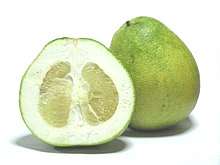
pomelos
Alternative forms
Etymology
Of uncertain etymology, though possibly a variant of earlier pampelmoes,[1] from French, Dutch, Portuguese sources ultimately equivalent to "thick lemon"[2] or transcribing the Tamil [script needed] (pampa limāsu, “big citrus”). Alternatively, possibly from pome (“apple”) + melon or some cognate; though such a compound is currently unattested, some early variant spellings seem to show influence from pome.[1]
Pronunciation
- (Received Pronunciation) enPR: pŏʹməlō, pŭʹməlō, pəmĕʹlō, IPA(key): /ˈpɒmɪləʊ/, /ˈpʌmɪləʊ/, /pəˈmɛləʊ/[1]
- (General American) enPR: pŏʹməlō, IPA(key): /ˈpɑməloʊ/[1]
Noun
pomelo (plural pomelos or pomeloes)
- The large fruit of the Citrus maxima or grandis, native to South Asia and Southeast Asia, with a thick green or yellow rind, a thick white pith, and semi-sweet translucent pale flesh.
- The tree which produces this fruit.
- The family of hybrids derived from this tree, particularly (inexact, uncommon US and South Africa) grapefruit.
Synonyms
- (true pomelo): jabong (India); shaddock (esp. Carribean); pampelmoes (South Africa); Chinese grapefruit (China)
- (grapefruit): See grapefruit
Descendants
Translations
large fruit of the C. maxima or grandis
|
|
tree
grapefruit — see grapefruit
References
- 1 2 3 4 “pomelo, n.”, in the Oxford English Dictionary, Oxford: Oxford University Press.
- ↑ “pampelmoes, n.”, in the Oxford English Dictionary, Oxford: Oxford University Press.
French
Pronunciation
- IPA(key): /pɔ.me.lo/
Noun
pomelo m (plural pomelos)
- Alternative spelling of pomélo
Galician
Noun
pomelo m (plural pomelos)
Portuguese
Etymology
Borrowed from English pomelo, from Dutch pompelmoes
Noun
pomelo m (plural pomelos)
- pomelo (large citric fruit native to southeast Asia)
Spanish
Etymology
Borrowed from English pomelo, from Dutch pompelmoes
Noun
pomelo m (plural pomelos)
Synonyms
- (grapefruit): toronja
This article is issued from
Wiktionary.
The text is licensed under Creative Commons - Attribution - Sharealike.
Additional terms may apply for the media files.