pierogi
English
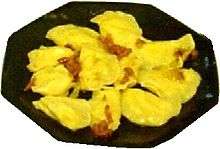
A plate of pierogi.
Alternative forms
Etymology
From Polish pierogi, singular pieróg, from Proto-Slavic *pir (“festivity, banquet”).
Pronunciation
- IPA(key): /pəˈɹoːɡi/, IPA(key): /pɛˈɾoːɡi/ (amongst Polish Americans)
Audio (file) - Hyphenation: pier‧ogi
Noun
pierogi (plural pierogi or pierogies or pierogis)
- (Canada, US) A square- or crescent-shaped dumpling of unleavened dough, stuffed with sauerkraut, cheese, mashed potatoes, cabbage, onion, meat, or any combination of these, or with a fruit filling.
Usage notes
- Russian "pirozhki" (пирожки́ (pirožkí)) and "pirogi" (singular "pirog", Russian пироги́ (pirogí)) and Polish pierogi (diminutive: "pierożki") (dumplings) are often confused. The two dishes are quite different. See pelmeni for the Russian version of the Polish pierogi. In certain regions of the Ukraine, these terms (пироги́, пиріжки́) may refer to either the Polish "pierogi" or the Russian "pirozhki".
Synonyms
Derived terms
- Chinese perogy
Translations
dumpling
|
See also
- potsticker
- pirozhki (Russian pastry, false friends)

References
- “pierogi” in the Katherine Barker, editor, Canadian Oxford Dictionary, 2nd edition, Don Mills, Ont.; Oxford: Oxford University Press, 2004, →ISBN.
Anagrams
Polish
Pronunciation
- IPA(key): ˈpʲɛ.rɔˈɡʲ.i
Noun
pierogi pl
- pierogi (dish)
Declension
Noun
pierogi
This article is issued from
Wiktionary.
The text is licensed under Creative Commons - Attribution - Sharealike.
Additional terms may apply for the media files.