oryx
See also: Oryx
English
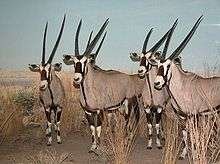
oryxes (Oryx leucoryx)
Etymology
From Latin, from Ancient Greek ὄρυξ (órux, “a pickax; an oryx (the antelope)”).
Noun
oryx (plural oryxes or oryx)
- Any of several antelopes, of genus Oryx, native to Africa, the males and females of which have long, straight horns.
Synonyms
- sabre antelope
Translations
antelope
Anagrams
Latin
Etymology
From Ancient Greek ὄρυξ (órux), the antelope probably being named after the sharp iron digging tools with the same name, because of the shape of its horns.
Pronunciation
- (Classical) IPA(key): /ˈo.ryks/, [ˈɔ.rʏks]
Noun
Oryges (Oryx leucoryx)
oryx m (genitive orygis); third declension
Inflection
Third declension.
| Case | Singular | Plural |
|---|---|---|
| nominative | oryx | orygēs |
| genitive | orygis | orygum |
| dative | orygī | orygibus |
| accusative | orygem | orygēs |
| ablative | oryge | orygibus |
| vocative | oryx | orygēs |
References
- oryx in Charlton T. Lewis and Charles Short (1879) A Latin Dictionary, Oxford: Clarendon Press
- oryx in Charlton T. Lewis (1891) An Elementary Latin Dictionary, New York: Harper & Brothers
- oryx in Gaffiot, Félix (1934) Dictionnaire Illustré Latin-Français, Hachette
- oryx in The Perseus Project (1999) Perseus Encyclopedia
- oryx in William Smith, editor (1854, 1857) A Dictionary of Greek and Roman Geography, volume 1 & 2, London: Walton and Maberly
This article is issued from
Wiktionary.
The text is licensed under Creative Commons - Attribution - Sharealike.
Additional terms may apply for the media files.