mite
English
Etymology
Middle English mite, from Old English mīte (“mite, tiny insect”), from Proto-Germanic *mītǭ (“biting insect"; literally, "cutter”), from Proto-Germanic *maitaną (“to cut”), from Proto-Indo-European *mey- (“small”) or *mai- (“to cut”). Akin to Old High German mīza (“mite”), Middle Dutch mīte (“moth, mite”), Dutch mijt (“moth, mite”), Danish mide (“mite”).
Pronunciation
- (Received Pronunciation, General American) enPR: mīt, IPA(key): /maɪt/
Audio (GA) (file) - Rhymes: -aɪt
- Homophone: might
Noun
mite (plural mites)
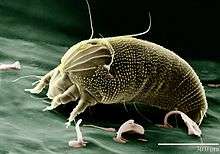
- A minute arachnid, of the order Acarina, of which there are many species.
- A small coin formerly circulated in England, rated at about a third of a farthing.
- 1803, William Blake, Auguries of Innocence
- One mite wrung from the lab'rer's hands
- Shall buy and sell the miser's lands;
- 1803, William Blake, Auguries of Innocence
- A lepton, a small coin used in Palestine in the time of Christ.
- A small weight; one twentieth of a grain.
- (sometimes used adverbially) Anything very small; a minute object; a very little quantity or particle
- 1913, Joseph C. Lincoln, chapter 5, in Mr. Pratt's Patients:
- “Well,” I says, “I cal'late a body could get used to Tophet if he stayed there long enough.” ¶ She flared up; the least mite of a slam at Doctor Wool was enough to set her going.
- 1959, Frances Cavanah, Abe Lincoln Gets His Chance, Project Gutenberg, :
- "Those trousers are a mite too big, but you'll soon grow into them."
- 1956, Janice Holt Giles, Hannah Fowler
- "Silas, now," Esther Whitley had said, "would be a good one for you, Hannah. He's a mite on the old side, but he's steady, an' he's been wed before. He knows the ways of a woman better'n some.
-
- (colloquial, often used affectionately) A small or naughty person, or one you take pity on; rascal
- 2014, Lorraine F Elli, The Little Town Mouse
- “Tom told me that, but twasn't your fault, the little mite just couldn't wait to be born that's all.” A small smile played on Leah's lips
- 2014, Lorraine F Elli, The Little Town Mouse
Synonyms
- (small amount): see also Thesaurus:modicum.
Derived terms
- bee mite
- bird mite
- carpet mite
- cheese mite
- dust mite
- flour mite
- fruit mite
- harvest mite
- house mouse mite
- itch mite
- rust mite
- spider mite
- sugar mite
- trombiculid mite
- tropical rat mite
- widow's mite
Translations
|
|
|
Verb
mite
- Eye dialect spelling of might.
Anagrams
Au
Noun
mite
References
- transnewguinea.org, citing D. C. Laycock, Languages of the Lumi Subdistrict (West Sepik District), New Guinea (1968), Oceanic Linguistics, 7 (1): 36-66
Catalan
Pronunciation
Noun
mite m (plural mites)
Related terms
Further reading
- “mite” in Diccionari de la llengua catalana, segona edició, Institut d’Estudis Catalans.
French
Etymology
Middle French, from Old French mitte (“kind of insect which gnaws on cloth or cheese”), from Middle Dutch mīte (“moth, mite”), ultimately from Proto-Germanic *mītǭ (“biting insect”, literally “cutter”), from *maitaną (“to cut”).
Akin to Old English mīte (“mite, tiny insect”), Old High German mīza (“mite”), Danish mide (“mite”).
Pronunciation
- IPA(key): /mit/
audio (file)
Noun
mite f (plural mites)
Derived terms
Related terms
Verb
mite
Further reading
- “mite” in le Trésor de la langue française informatisé (The Digitized Treasury of the French Language).
Anagrams
Italian
Etymology
Adjective
mite (masculine and feminine plural miti)
Anagrams
Latin
Adjective
mīte
References
- mite in Charlton T. Lewis and Charles Short (1879) A Latin Dictionary, Oxford: Clarendon Press
- mite in Charlton T. Lewis (1891) An Elementary Latin Dictionary, New York: Harper & Brothers
Norman
Etymology
From Old French mitte (“kind of insect which gnaws on cloth or cheese”), from Middle Dutch mīte (“moth, mite”), ultimately from Proto-Germanic *mītǭ (“biting insect”, literally “cutter”).
Noun
mite f (plural mites)
Volapük
Noun
mite
- dative singular of mit