mꜣꜥt
Egyptian
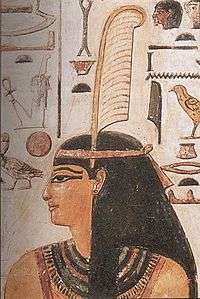
The goddess
, personification of truth and right
|


Etymology
An abstract noun formed from mꜣꜥ (“to direct, to be just, to be true”) + -t (“feminine ending”).
Pronunciation
- (reconstructed) IPA(key): /ˈmuʀʕat/ → /ˈmuʀʕaʔ/ → /ˈmuʔʕəʔ/ → /ˈmøʔʕə/[1]
- (modern Egyptological) IPA(key): /mɑʔɑːt/
- Conventional anglicization: maat
Noun
|

f
- truth
- right action, righteousness, virtue
- blamelessness, innocence
- justice, fairness
- right order in the state or cosmos
Alternative forms
Alternative hieroglyphic writings of mꜣꜥt
|
|
|
|||||||||||||||||||
| mꜣꜥt | mꜣꜥt | mꜣꜥt | |||||||||||||||||||


Antonyms
Descendants
Proper noun
|
f
- Maat, the goddess personifying the above concepts
References
- Erman, Adolf; Grapow, Hermann (1926-1961) Wörterbuch der ägyptischen Sprache, Berlin: Akademie-Verlag, →ISBN
- Allen, James (2010) Middle Egyptian: An Introduction to the Language and Culture of Hieroglyphs, revised second edition, Cambridge: Cambridge University Press, →ISBN
- Hoch, James (1997) Middle Egyptian Grammar, Mississauga: Benben Publications, →ISBN, page 112
- ↑ Loprieno, Antonio (1995) Ancient Egyptian: A Linguistic Introduction, Cambridge: Cambridge University Press, →ISBN, page 39, 47
This article is issued from
Wiktionary.
The text is licensed under Creative Commons - Attribution - Sharealike.
Additional terms may apply for the media files.