mũgumo
Kikuyu
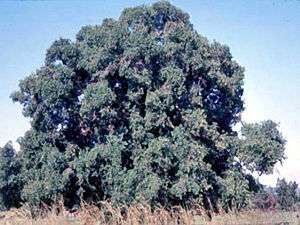
mũgumo (F. thonningii)
Pronunciation
- IPA(key): /mòɣùmɔ̀ꜜ/
- As for Tonal Class, Benson (1964) classifies this term into Class 1 with a disyllabic stem, together with ndaka, and so on.
- (Kiambu)
- (Limuru) As for Tonal Class, Yukawa (1981) classifies this term into a group including cindano, huko, iburi, igego, igoti, ini (pl. mani), inooro, irigũ, irũa, iturubarĩ (pl. maturubarĩ), kĩbaata, kĩmũrĩ, kũgũrũ, mũciĩ, mũgeni, mũgũrũki, mũmbirarũ, mũndũ, mũri, mũthuuri, mwaki (“fire”), mwario (“way of speaking”), mbogoro, nda, ndaka, ndigiri, ngo, njagathi, njogu, nyondo (“breast(s)”), and so on.[1]
Noun
mũgumo class 3 (plural mĩgumo)
- Any of several species of the genus Ficus; regarded as sacred by Kikuyu people[2][3] and decoction of its bark with milk is used for treating dysentery[2]
- wild fig,[4] stranger fig[4] (Ficus thonningii)[4]
- bark cloth fig (Ficus natalensis)[5][6]
See also
- mũkũyũ, mũũmbũ
References
- ↑ Yukawa, Yasutoshi (1981). "A Tentative Tonal Analysis of Kikuyu Nouns: A Study of Limuru Dialect." In Journal of Asian and African Studies, No. 22, 75–123.
- 1 2 “mũgumo” in Benson, T.G. (1964). Kikuyu-English dictionary, p. 122. Oxford: Clarendon Press.
- ↑ Napoli, Donna Jo (2010). Mama Miti: Wangari Maathai and the Trees of Kenya. Simon & Schuster.
- 1 2 3 Dharani, Najma (2002). Field Guide to Common Trees & Shrubs of East Africa, p. 113. Cape Town: Struik Publishers. Rep. 2005. →ISBN
- ↑ Dharani, op. cit., p. 110.
- ↑ A Guide to Trees in Kenya Useful for Agroforestry. (Retrieved 11 December 2017)
This article is issued from
Wiktionary.
The text is licensed under Creative Commons - Attribution - Sharealike.
Additional terms may apply for the media files.