lemur
English
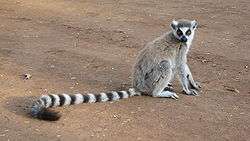
Ring-tailed lemur (Lemur catta)
Etymology
From Latin lemurēs pl (“spirits of the dead”). The name was originally given to the slender loris (then Lemur tardigradus) in 1754 by Carl Linnaeus. According to Linnaeus, the name was selected because of the nocturnal activity and slow movements of the slender loris. In 1758, Linnaeus added—among others—the ring-tailed lemur (Lemur catta) to the genus Lemur. All other species, including the slender loris, were eventually moved to other genera. In time, the word became the colloquial name for all primates endemic to Madagascar.[1]
Pronunciation
- IPA(key): /ˈliːmə(ɹ)/
- Rhymes: -iːmə(r)
- Homophone: Lima (in non-rhotic accents)
Noun
lemur (plural lemurs)
- (colloquial) Any strepsirrhine primate of the infraorder Lemuriformes, superfamily Lemuroidea, native only to Madagascar and some surrounding islands.
- The genus Lemur, represented by the ring-tailed lemur (Lemur catta).
- 1758, Linnaeus, C., Systema Naturæ, volume 1, 10 edition, Stockholm, Sweden: Laurentius Salvius, pages 29–30:
-
- (obsolete) The genus for a loris (Lemur tardigradus, now Loris tardigradus), predating the 10th edition of Systema Naturæ.
- 1754, Linnaeus, C., Museum Adolphi Friderici Regis, Stockholm, Sweden: Typographia Regia, page 3–4:
- "Lemures dixi hos, quod noctu imprimis obambulant, hominibus quodanmodo similes, & lento passu vagantur."
- [I call them lemurs, because they go around mainly by night, in a certain way similar to humans, and roam with a slow pace.]
- "Lemures dixi hos, quod noctu imprimis obambulant, hominibus quodanmodo similes, & lento passu vagantur."
-
Usage notes
The taxonomy is currently disputed, see 
Derived terms
terms derived from lemur (noun)
- Archaeolemur
- Archaeolemuridae
- bamboo lemur
- dwarf lemur
- Eulemur
- fork-marked lemur
- giant mouse lemur
- hairy-eared dwarf lemur
- Hapalemur
- Lemuridae
- lemuriform
- Lemuriformes
- lemuroid
- Lemuroidea
- Lepilemur
- Lepilemuridae
- mouse lemur
- Pachylemur
- ring-tailed lemur
- ruffed lemur
- sportive lemur
- subfossil lemur
- true lemur
- woolly lemur
Related terms
Translations
strepsirrhine primate of the infraorder Lemuriformes, superfamily Lemuroidea
|
|
References
- ↑ A. R. Dunkel; J. S. Zijlstra; C. P. Groves (2011/2012), “Giant Rabbits, Marmosets, and British Comedies: Etymology of Lemur Names, Part 1”, in Lemur News, volume 16, retrieved 11 April 2013, pages 64–70.
Further reading


Czech
Noun
lemur m
Derived terms
Further reading
- lemur in Příruční slovník jazyka českého, 1935–1957
- lemur in Slovník spisovného jazyka českého, 1960–1971, 1989
Icelandic
Verb
lemur (weak)
- second-person singular present indicative of lemja
- third-person singular present indicative of lemja
Polish
Noun
lemur m anim
- lemur (primate)
Declension
declension of lemur
| singular | plural | |
|---|---|---|
| nominative | lemur | lemury |
| genitive | lemura | lemurów |
| dative | lemurowi | lemurom |
| accusative | lemura | lemury |
| instrumental | lemurem | lemurami |
| locative | lemurze | lemurach |
| vocative | lemurze | lemury |
Serbo-Croatian
Pronunciation
- IPA(key): /lěmuːr/
- Hyphenation: le‧mur
Noun
lèmūr m (Cyrillic spelling лѐмӯр)
Declension
Declension of lemur
Swedish
Noun
lemur c
- a lemur
Declension
| Declension of lemur | ||||
|---|---|---|---|---|
| Singular | Plural | |||
| Indefinite | Definite | Indefinite | Definite | |
| Nominative | lemur | lemuren | lemurer | lemurerna |
| Genitive | lemurs | lemurens | lemurers | lemurernas |
This article is issued from
Wiktionary.
The text is licensed under Creative Commons - Attribution - Sharealike.
Additional terms may apply for the media files.