lava
English
Etymology
From Italian lava (“lava”), originally, in Naples, a torrent of rain overflowing the streets, from lavare (“to wash”). See etymology for the English verb lave.
Pronunciation
Noun
lava (countable and uncountable, plural lavas)
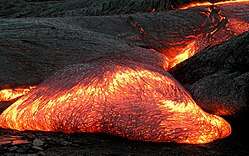
- The molten rock ejected by a volcano from its crater or fissured sides.
- (informal, proscribed) Magma.
- A shade of red, named after the volcanic lava.
- lava colour:
-
Usage notes
Geologists make a distinction between magma (molten rock underground) and lava (molten rock on the surface).
Derived terms
Related terms
Translations
|
|
- The translations below need to be checked and inserted above into the appropriate translation tables, removing any numbers. Numbers do not necessarily match those in definitions. See instructions at Wiktionary:Entry layout#Translations.
|
See also
Anagrams
Catalan
Noun
lava f (plural laves)
Crimean Tatar
Etymology
Noun
lava
Declension
| nominative | lava |
|---|---|
| genitive | lavanıñ |
| dative | lavağa |
| accusative | lavanı |
| locative | lavada |
| ablative | lavadan |
References
- Mirjejev, V. A.; Usejinov, S. M. (2002) Ukrajinsʹko-krymsʹkotatarsʹkyj slovnyk [Ukrainian – Crimean Tatar Dictionary], Simferopol: Dolya, →ISBN
Dutch
Pronunciation
-
Audio (file)
Hyphenation: la‧va
Noun
lava c (uncountable)
Estonian
Noun
lava (genitive [please provide], partitive [please provide])
Finnish
Etymology
From Old East Slavic лава (lava), from Proto-Slavic *lava
Noun
lava
- bed (platform of a truck or other vehicle that supports the load)
- platform (raised stage for speeches etc.)
- stage (in a theatre etc.)
Declension
| Inflection of lava (Kotus type 9/kala, no gradation) | |||
|---|---|---|---|
| nominative | lava | lavat | |
| genitive | lavan | lavojen | |
| partitive | lavaa | lavoja | |
| illative | lavaan | lavoihin | |
| singular | plural | ||
| nominative | lava | lavat | |
| accusative | nom. | lava | lavat |
| gen. | lavan | ||
| genitive | lavan | lavojen lavainrare | |
| partitive | lavaa | lavoja | |
| inessive | lavassa | lavoissa | |
| elative | lavasta | lavoista | |
| illative | lavaan | lavoihin | |
| adessive | lavalla | lavoilla | |
| ablative | lavalta | lavoilta | |
| allative | lavalle | lavoille | |
| essive | lavana | lavoina | |
| translative | lavaksi | lavoiksi | |
| instructive | — | lavoin | |
| abessive | lavatta | lavoitta | |
| comitative | — | lavoineen | |
Compounds
- avolava
- kuormalava
- lavakuorma-auto
- lavashow
- lavasäteily
- tanssilava
Anagrams
French
Verb
lava
- third-person singular past historic of laver
Anagrams
Galician
Noun
lava f (plural lavas)
Italian
Verb
lava
Noun
lava f (plural lave)
Related terms
Latin
Verb
lavā
- first-person singular present active imperative of lavō
Norwegian Bokmål
Etymology 1
From Italian lava (Neapolitan dialect)
Noun
lava m (definite singular lavaen, indefinite plural lavaer, definite plural lavaene)
Derived terms
Etymology 2
Alternative forms
Noun
lava m, n
- definite neuter plural of lav
References
- “lava” in The Bokmål Dictionary.
Norwegian Nynorsk
Etymology 1
From Italian lava (Neapolitan dialect)
Noun
lava m (definite singular lavaen, indefinite plural lavaer, definite plural lavaene)
Etymology 2
Noun
lava n
- definite plural of lav
References
- “lava” in The Nynorsk Dictionary.
Portuguese
Pronunciation
Etymology 1
From Italian (Neapolitan or Calabrese dialect), lava (“a torrent of rain which washed the streets”), from Latin lavō (“I wash”), from Proto-Indo-European *lowh₃-
Noun
lava f (plural lavas)
- lava (melted rock)
Related terms
Etymology 2
Verb
lava
- third-person singular (ele and ela, also used with você and others) present indicative of lavar
- second-person singular (tu, sometimes used with você) affirmative imperative of lavar
Serbo-Croatian
Noun
láva f (Cyrillic spelling ла́ва)
Declension
Spanish
Etymology
From Italian (Neapolitan dialect) lava (“lava”), from lavare (“to wash”).
Noun
lava f (plural lavas)
Verb
lava
Veps
Etymology
Related to Finnish lava.
Noun
lava
Inflection
| Inflection of lava | |||
|---|---|---|---|
| nominative sing. | lava | ||
| genitive sing. | lavan | ||
| partitive sing. | lavad | ||
| partitive plur. | lavoid | ||
| singular | plural | ||
| nominative | lava | lavad | |
| accusative | lavan | lavad | |
| genitive | lavan | lavoiden | |
| partitive | lavad | lavoid | |
| essive-instructive | lavan | lavoin | |
| translative | lavaks | lavoikš | |
| inessive | lavas | lavoiš | |
| elative | lavaspäi | lavoišpäi | |
| illative | ? | lavoihe | |
| adessive | laval | lavoil | |
| ablative | lavalpäi | lavoilpäi | |
| allative | lavale | lavoile | |
| abessive | lavata | lavoita | |
| comitative | lavanke | lavoidenke | |
| prolative | lavadme | lavoidme | |
| approximative I | lavanno | lavoidenno | |
| approximative II | lavannoks | lavoidennoks | |
| egressive | lavannopäi | lavoidennopäi | |
| terminative I | ? | lavoihesai | |
| terminative II | lavalesai | lavoilesai | |
| terminative III | lavassai | — | |
| additive I | ? | lavoihepäi | |
| additive II | lavalepäi | lavoilepäi | |