jury
See also: Jury
English
Pronunciation
- IPA(key): /ˈdʒʊəɹi/, /ˈdʒɝi/
| Audio (US) | (file) |
- Rhymes: -ʊəɹi
Etymology 1
From Middle English jure, from Anglo-Norman juree, from Medieval Latin iūrāta, from Latin iūrō (“I swear or take an oath”).
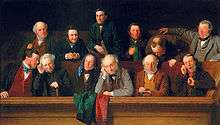
The Jury an 1861 painting of a British jury
Noun
jury (plural juries)
- (law) A group of individuals chosen from the general population to hear and decide a case in a court of law.
- "And so the jury and he approached, as if this were a time of peace instead of one of the greatest world disturbances ever known in history, the question whether the prosecution had proved to the jury’s satisfaction that George Joseph Smith was guilty of murder. The jury were the shield which stood between him and death, unless, to the jury’s satisfaction, he was proved to be guilty. Yet while they were the shield of the man accused, they were also the Sword of the State; and if the man were proved guilty, they were the servants of the State to punish him. Their respective functions were these: he the judge, had to settle the law, and the jury must take the law from him. The jury were judges of fact."
- 1952: James Avery Joyce: Justice At Work: (this edition Pan 1957) Page 92. commenting on R v Smith [1915] 84 LJKB 2153 (1914-15 All ER 262 CCA)
- "And so the jury and he approached, as if this were a time of peace instead of one of the greatest world disturbances ever known in history, the question whether the prosecution had proved to the jury’s satisfaction that George Joseph Smith was guilty of murder. The jury were the shield which stood between him and death, unless, to the jury’s satisfaction, he was proved to be guilty. Yet while they were the shield of the man accused, they were also the Sword of the State; and if the man were proved guilty, they were the servants of the State to punish him. Their respective functions were these: he the judge, had to settle the law, and the jury must take the law from him. The jury were judges of fact."
- A group of judges in a competition.
Meronyms
Derived terms
Terms derived from jury
Descendants
- Portuguese: júri
Translations
group in a court of law
|
|
group of judges in a competition
|
|
Verb
jury (third-person singular simple present juries, present participle jurying, simple past and past participle juried)
- To judge by means of a jury.
Etymology 2
Early 1600s. Perhaps ultimately from Old French ajurie, from Latin adiūtō.
Adjective
jury (not comparable)
Derived terms
Translations
(nautical) for temporary use
|
|
Dutch
Pronunciation
-
audio (file) - IPA(key): /ˈʒyː.ri/
- Hyphenation: ju‧ry
Noun
jury f (plural jury's, diminutive jury'tje n)
French
Etymology
Pronunciation
- IPA(key): /ʒy.ʁi/
Noun
jury m (plural jurys)
Related terms
Further reading
- “jury” in le Trésor de la langue française informatisé (The Digitized Treasury of the French Language).
Norman
Etymology
Noun
jury m (plural jurys)
Norwegian Bokmål
Etymology
Noun
jury m (definite singular juryen, indefinite plural juryer, definite plural juryene)
References
- “jury” in The Bokmål Dictionary.
Norwegian Nynorsk
Etymology
Noun
jury m (definite singular juryen, indefinite plural juryar, definite plural juryane)
References
- “jury” in The Nynorsk Dictionary.
Polish
Etymology
Pronunciation
- IPA(key): [ʐɨˈrʲi]
Noun
jury n (indeclinable)
- jury (a group of judges in a competition)
This article is issued from
Wiktionary.
The text is licensed under Creative Commons - Attribution - Sharealike.
Additional terms may apply for the media files.