incubus
See also: Incubus
English
WOTD – 27 May 2010
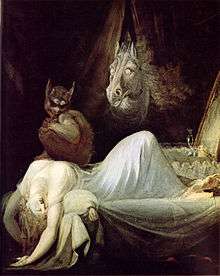
1802 portrait of an incubus.
Etymology
From Late Latin incubus, from Latin incubo (“nightmare, one who lies down on the sleeper”), from incubāre (“to lie upon, to hatch”), from in- (“on”) + cubāre (“to lie”).
Pronunciation
Noun
incubus (plural incubi or incubuses)
- (mediaeval folklore) An evil spirit supposed to oppress people while asleep, especially to have sex with women as they sleep.
- Antonym: succubus
- A feeling of oppression during sleep, sleep paralysis; night terrors, a nightmare.
- Synonym: nightmare
- 1621, Democritus Junior [pseudonym; Robert Burton], The Anatomy of Melancholy, Oxford: Printed by Iohn Lichfield and Iames Short, for Henry Cripps, OCLC 216894069; The Anatomy of Melancholy: […], 2nd corrected and augmented edition, Oxford: Printed by John Lichfield and James Short, for Henry Cripps, 1624, OCLC 54573970, (please specify |partition=1, 2, or 3):, vol. I, New York 2001, p.249:
- it increaseth fearful dreams, incubus, night-walking, crying out, and much unquietness […].
- (by extension) Any oppressive thing or person; a burden.
- 2002, Colin Jones, The Great Nation, Penguin 2003, p. 132-3:
- Notions of civic virtue were at that moment changing, in ways which would make of Louis's alleged vices an incubus on the back of the monarchy.
- 2002, Colin Jones, The Great Nation, Penguin 2003, p. 132-3:
- (entomology) One of various of parasitic insects, especially subfamily Aphidiinae.
Hypernyms
- (an evil spirit): evil spirit, spirit
Translations
an evil spirit
|
|
a nightmare
oppressive thing or person; a burden
See also
Further reading

Dutch
Etymology
From Late Latin incubus, from Latin incubo (“nightmare, one who lies down on the sleeper”), from incubare (“to lie upon, to hatch”).
Noun
incubus m (plural incubussen or incubi, diminutive incubusje n)
Synonyms
- (nightmare) nachtmerrie
See also
- succubus m
Latin
Etymology
From incubō¹ (“I lie upon”, “I brood over”, “I am a burden to”), perhaps via an alteration of the Classical incubō² (“incubus”, “nightmare”).
Pronunciation
- (Classical) IPA(key): /ˈin.ku.bus/, [ˈɪŋ.kʊ.bʊs]
Noun
incubus m (genitive incubī); second declension
- (Late Latin) the nightmare, incubus
- (Can we find and add a quotation of Augustine of Hippo to this entry?)
- (Can we find and add a quotation of Isidore of Seville to this entry?)
Declension
Second declension.
| Case | Singular | Plural |
|---|---|---|
| nominative | incubus | incubī |
| genitive | incubī | incubōrum |
| dative | incubō | incubīs |
| accusative | incubum | incubōs |
| ablative | incubō | incubīs |
| vocative | incube | incubī |
Synonyms
- (nightmare, incubus): incubitor, incubō
Descendants
References
- incŭbus in Charlton T. Lewis and Charles Short (1879) A Latin Dictionary, Oxford: Clarendon Press
- INCUBI in Charles du Fresne du Cange’s Glossarium Mediæ et Infimæ Latinitatis (augmented edition, 1883–1887)
- incŭbus in Gaffiot, Félix (1934) Dictionnaire Illustré Latin-Français, Hachette, page 801/1
- Niermeyer, Jan Frederik (1976), “incubo (genet. -onis), incubus”, in Mediae Latinitatis Lexicon Minus (in Latin), Leiden, Boston: Brill, page 524/2
This article is issued from
Wiktionary.
The text is licensed under Creative Commons - Attribution - Sharealike.
Additional terms may apply for the media files.