hórreo
See also: horreo
Galician
FWOTD – 1 February 2014
Alternative forms
- hórneo, horrio, horro
hórreo

Como os monges s'acharon outro dia os orrios chẽos de muy bõo triigo: "How the monks found the nest day that the granaries were filled with excellent wheat". 13th century. Cantigas de Santa María
Etymology
From Old Portuguese orreo (compare Portuguese hôrreo), from Latin horreum (“storehouse; granary”), from Ancient Greek ὡρεῖον (hōreîon).
Pronunciation
- IPA(key): /ˈo.re.o/
Noun
hórreo m (plural hórreos)
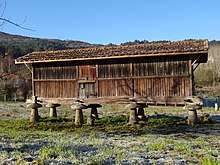
- a granary placed on top of pillars, corn crib
- 2011, Robert Skyler, Fragmentos Terra: S. S. H. U. T., Palibrio, page 19
- Pediu o apoio da artillería e ó mediodía o hórreo estoupou en anacos.
- He asked for artillery support and at noon the raised granary was blasted to bits.
- Pediu o apoio da artillería e ó mediodía o hórreo estoupou en anacos.
- 2011, Robert Skyler, Fragmentos Terra: S. S. H. U. T., Palibrio, page 19
Synonyms
References
- “orreo” in Dicionario de Dicionarios do galego medieval, SLI - ILGA 2006-2012.
- “horreo” in Dicionario de Dicionarios da lingua galega, SLI - ILGA 2006-2013.
- “hórreo” in Santamarina, Antón (coord.): Tesouro informatizado da lingua galega. Santiago de Compostela: Instituto da Lingua Galega.
- “hórreo” in Álvarez, Rosario (coord.): Tesouro do léxico patrimonial galego e portugués, Santiago de Compostela: Instituto da Lingua Galega.
Spanish
Alternative forms
- orrio (dialectal, regional)
Etymology
From Latin horreum, from Ancient Greek ὡρεῖον (hōreîon). It seems to be an inherited term, although the 'e' in the main form may have been the result of later learned modification[1]. Compare Asturian horriu, orru, Catalan orri.
Pronunciation
- IPA(key): /ˈoreo/
Noun
hórreo m (plural hórreos)
- granary (storehouse)
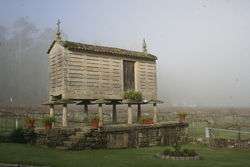
- An isolated, rectangular, wooden or rock building supported by columns, characteristic of the northwest of the Iberian peninsula and typically used to store grain or other agricultural produce.
Derived terms
- hórreo gallego
See also
References
This article is issued from
Wiktionary.
The text is licensed under Creative Commons - Attribution - Sharealike.
Additional terms may apply for the media files.