geta
English
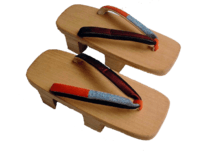
Geta
Etymology
Noun
geta (plural getas or geta)
- A Japanese raised wooden clog, worn with traditional Japanese garments such as the kimono.
- 1982 July, Robert Dillon, Geta As A Karate Training Tool, Black Belt, page 70,
- The Japanese geta or wooden sandal is a superb, though little-utilized, tool for training in the martial arts. […] The geta are flat, wooden sandals raised on vertical slats.
- 1982 July, Robert Dillon, Geta As A Karate Training Tool, Black Belt, page 70,
Translations
See also
Anagrams
Icelandic
Etymology
From Old Norse geta (whence also English get), from Proto-Germanic *getaną, from Proto-Indo-European *gʰed- (“take, seize”). Compare Danish gide, Swedish gitta.
Pronunciation
- IPA(key): /ˈcɛːta/ (
)listen (file) - Rhymes: -ɛːta
Verb
geta (strong verb, third-person singular past indicative gat, third-person plural past indicative gátum, supine getið)
Conjugation
geta — active voice (germynd)
| infinitive (nafnháttur) |
að geta | ||||
|---|---|---|---|---|---|
| supine (sagnbót) |
getið | ||||
| present participle (lýsingarháttur nútíðar) |
getandi | ||||
| indicative (framsöguháttur) |
subjunctive (viðtengingarháttur) | ||||
| present (nútíð) |
ég get | við getum | present (nútíð) |
ég geti | við getum |
| þú getur | þið getið | þú getir | þið getið | ||
| hann, hún, það getur | þeir, þær, þau geta | hann, hún, það geti | þeir, þær, þau geti | ||
| past (þátíð) |
ég gat | við gátum | past (þátíð) |
ég gæti | við gætum |
| þú gast | þið gátuð | þú gætir | þið gætuð | ||
| hann, hún, það gat | þeir, þær, þau gátu | hann, hún, það gæti | þeir, þær, þau gætu | ||
| imperative (boðháttur) |
get (þú) | getið (þið) | |||
| Forms with appended personal pronoun | |||||
| gettu | getiði * | ||||
| * Spoken form, usually not written; in writing, the unappended plural form (optionally followed by the full pronoun) is preferred. | |||||
| infinitive (nafnháttur) |
að getast | ||||
|---|---|---|---|---|---|
| supine (sagnbót) |
getist | ||||
| present participle (lýsingarháttur nútíðar) |
getandist ** ** the mediopassive present participle is extremely rare and normally not used; it is never used attributively or predicatively, only for explicatory subclauses | ||||
| indicative (framsöguháttur) |
subjunctive (viðtengingarháttur) | ||||
| present (nútíð) |
ég gest | við getumst | present (nútíð) |
ég getist | við getumst |
| þú gest | þið getist | þú getist | þið getist | ||
| hann, hún, það gest | þeir, þær, þau getast | hann, hún, það getist | þeir, þær, þau getist | ||
| past (þátíð) |
ég gast | við gátumst | past (þátíð) |
ég gætist | við gætumst |
| þú gast | þið gátust | þú gætist | þið gætust | ||
| hann, hún, það gast | þeir, þær, þau gátust | hann, hún, það gætist | þeir, þær, þau gætust | ||
| imperative (boðháttur) |
gest (þú) | getist (þið) | |||
| Forms with appended personal pronoun | |||||
| gestu | getisti * | ||||
| * Spoken form, usually not written; in writing, the unappended plural form (optionally followed by the full pronoun) is preferred. | |||||
getinn — past participle (lýsingarháttur þátíðar)
| strong declension (sterk beyging) |
singular (eintala) | plural (fleirtala) | |||||
|---|---|---|---|---|---|---|---|
| masculine (karlkyn) |
feminine (kvenkyn) |
neuter (hvorugkyn) |
masculine (karlkyn) |
feminine (kvenkyn) |
neuter (hvorugkyn) | ||
| nominative (nefnifall) |
getinn | getin | getið | getnir | getnar | getin | |
| accusative (þolfall) |
getinn | getna | getið | getna | getnar | getin | |
| dative (þágufall) |
getnum | getinni | getnu | getnum | getnum | getnum | |
| genitive (eignarfall) |
getins | getinnar | getins | getinna | getinna | getinna | |
| weak declension (veik beyging) |
singular (eintala) | plural (fleirtala) | |||||
| masculine (karlkyn) |
feminine (kvenkyn) |
neuter (hvorugkyn) |
masculine (karlkyn) |
feminine (kvenkyn) |
neuter (hvorugkyn) | ||
| nominative (nefnifall) |
getni | getna | getna | getnu | getnu | getnu | |
| accusative (þolfall) |
getna | getnu | getna | getnu | getnu | getnu | |
| dative (þágufall) |
getna | getnu | getna | getnu | getnu | getnu | |
| genitive (eignarfall) |
getna | getnu | getna | getnu | getnu | getnu | |
Usage notes
- Geta exceptionally requires the supine (sagnbót) form of an accompanying verb, rather than the bare infinitive.
Derived terms
See also
Noun
geta f (genitive singular getu, nominative plural getur)
Declension
declension of geta
Japanese
Romanization
geta
Malay
Noun
geta
Old Norse
Etymology
From Proto-Germanic *getaną.
Verb
geta (singular past indicative gat, plural past indicative gátu, past participle getinn)
Conjugation
Conjugation of geta — active (strong class 5)
| infinitive | geta | |
|---|---|---|
| present participle | getandi | |
| past participle | getinn | |
| indicative | present | past |
| 1st-person singular | get | gat |
| 2nd-person singular | getr | gazt |
| 3rd-person singular | getr | gat |
| 1st-person plural | getum | gátum |
| 2nd-person plural | getið | gátuð |
| 3rd-person plural | geta | gátu |
| subjunctive | present | past |
| 1st-person singular | geta | gæta |
| 2nd-person singular | getir | gætir |
| 3rd-person singular | geti | gæti |
| 1st-person plural | getim | gætim |
| 2nd-person plural | getið | gætið |
| 3rd-person plural | geti | gæti |
| imperative | present | |
| 2nd-person singular | get | |
| 1st-person plural | getum | |
| 2nd-person plural | getið | |
Conjugation of geta — mediopassive (strong class 5)
| infinitive | getask | |
|---|---|---|
| present participle | getandisk | |
| past participle | getizk | |
| indicative | present | past |
| 1st-person singular | getumk | gátumk |
| 2nd-person singular | gezk | gazk |
| 3rd-person singular | gezk | gazk |
| 1st-person plural | getumsk | gátumsk |
| 2nd-person plural | getizk | gátuzk |
| 3rd-person plural | getask | gátusk |
| subjunctive | present | past |
| 1st-person singular | getumk | gætumk |
| 2nd-person singular | getisk | gætisk |
| 3rd-person singular | getisk | gætisk |
| 1st-person plural | getimsk | gætimsk |
| 2nd-person plural | getizk | gætizk |
| 3rd-person plural | getisk | gætisk |
| imperative | present | |
| 2nd-person singular | gezk | |
| 1st-person plural | getumsk | |
| 2nd-person plural | getizk | |
Descendants
References
- geta in Geir T. Zoëga (1910) A Concise Dictionary of Old Icelandic, Oxford: Clarendon Press
Spanish
Etymology 1
Pronunciation 1
- IPA(key): [ˈɡe̞.ta̠]
Noun
geta f (plural getas)
- (footwear) geta.
Etymology 2
From Latin Geta, from Ancient Greek Γέτης (Gétēs).
Pronunciation 2
- IPA(key): [ˈxe̞.ta̠]
- Homophones: jeta
Noun
geta m, f (plural getas)
- (demonym) Geat.
This article is issued from
Wiktionary.
The text is licensed under Creative Commons - Attribution - Sharealike.
Additional terms may apply for the media files.