fort
English
Etymology
From Middle French fort (“strong”) (adjective use is of Old French).
Pronunciation
- (General American) IPA(key): /fɔɹt/
- (Received Pronunciation) IPA(key): /fɔːt/
- (rhotic, without the horse–hoarse merger) IPA(key): /fo(ː)ɹt/
- (non-rhotic, without the horse–hoarse merger) IPA(key): /foət/
Audio (US) (file) - Rhymes: -ɔː(ɹ)t
- Homophone: forte (one pronunciation); fought (non-rhotic accents with the horse–hoarse merger)
Noun
fort (plural forts)
- A fortified defensive structure stationed with troops.
- Any permanent army post.
- (historical) An outlying trading-station, as in British North America.
Derived terms
Related terms
Translations
|
|
- The translations below need to be checked and inserted above into the appropriate translation tables, removing any numbers. Numbers do not necessarily match those in definitions. See instructions at Wiktionary:Entry layout#Translations.
Verb
fort (third-person singular simple present forts, present participle forting, simple past and past participle forted)
- To create a fort, fortifications, a strong point, or a redoubt.
Anagrams
Catalan
Etymology
Adjective
fort (feminine forta, masculine plural forts, feminine plural fortes)
- strong (forceful, powerful)
- strong (durable, resistant)
- strong (potent, having a high degree of intensity)
Related terms
Adverb
fort
Noun
Interjection
fort
- Expressing approval of a punishment or misfortune suffered by another.
Danish
Noun
References
- “fort” in Den Danske Ordbog
Dutch
Pronunciation
Audio (file) - Rhymes: -ɔrt
Noun
Anagrams
French
Etymology
From Latin fortis (“strong”). Ultimately from Proto-Indo-European *bʰerǵʰ- (“fort”).
Pronunciation
- IPA(key): /fɔʁ/
audio (France) (file) audio (Quebec) (file)
Adjective
fort (feminine singular forte, masculine plural forts, feminine plural fortes)
- strong; powerful
- Arnie est fort. ― Arnie is strong.
- hommes forts ― strong men
- (informal) skilled, proficient, successful, sometimes translated "good" (often used in reference to academic subjects)
- Je suis fort en anglais ― I am good at English
Synonyms
Antonyms
Adverb
fort
- strongly
- much, a lot
- 2001, Le Funambule, page 141, →ISBN
- Alors on ferme les yeux, on a fort envie de quelque chose et on se l'offre.
- So we close our eyes, we really fancy something and we're going to take it.
- Alors on ferme les yeux, on a fort envie de quelque chose et on se l'offre.
- 2001, Le Funambule, page 141, →ISBN
- (when preceding an adjective) very (the adjective)
Related terms
Noun
fort m (plural forts)
- A fort
Related terms
Further reading
- “fort” in le Trésor de la langue française informatisé (The Digitized Treasury of the French Language).
German
Etymology
From Middle High German vort, Old High German forth, Proto-Germanic *furþa-, compare English forth, Dutch voort.
Pronunciation
- IPA(key): [fɔɐ̯t]
Audio (file)
Adverb
fort
Derived terms
- fortkommen
- in einem fort
- usf.
Related terms
Further reading
- fort in Duden online
Middle French
Adjective
fort m (feminine singular forte, masculine plural fors, feminine plural fortes)
Norman
Etymology
From Old French fort, from Latin fortis, from Proto-Indo-European *bʰerǵʰ-.
Adjective
fort m
Derived terms
- fortement (“strongly”)
Noun
fort m (plural forts)
Norwegian Bokmål
Pronunciation
- IPA(key): /fuʈ/
Etymology 1
From Middle Low German vort
Adverb
Etymology 2
Noun
fort n (definite singular fortet, indefinite plural fort or forter, definite plural forta or fortene)
References
- “fort” in The Bokmål Dictionary.
Norwegian Nynorsk
Etymology 1
From Middle Low German vort.
Pronunciation
- IPA(key): /furt/ (example of pronunciation)
Adjective
fort (indefinite singular fort, definite singular and plural forte, comparative fortare, indefinite superlative fortast, definite superlative fortaste)
Synonyms
- snøgg
Antonyms
Adverb
fort
Synonyms
- snøgt
Antonyms
Etymology 2
Pronunciation
- IPA(key): /fɔrt/ (example of pronunciation)
Noun
fort n (definite singular fortet, indefinite plural fort, definite plural forta)
Derived terms
- kystfort
References
- “fort” in The Nynorsk Dictionary.
Old French
Etymology
Pronunciation
- IPA(key): /fɔrt/
- Rhymes: -ɔrt
Adjective
fort m (oblique and nominative feminine singular fort or forte)
- strong
- late 12th century, anonymous, La Folie de Tristan d'Oxford, page 354 (of the Champion Classiques edition of Le Roman de Tristan, →ISBN, lines 67-70:
- La nef ert fort e belle e grande,
bone cum cele k'ert markande.
De plusurs mers chargee esteit,
en Engleterre curre devait.- The ship was strong and beautiful and big,
good like a merchant's ship
loaded with lots of different type of merchandise
ready to set sail to England.
- The ship was strong and beautiful and big,
- La nef ert fort e belle e grande,
-
Declension
Adverb
fort
Related terms
Old Irish
Pronoun
fort
Descendants
Polish
Etymology
Pronunciation
- IPA(key): /fɔrt/
Audio (file)
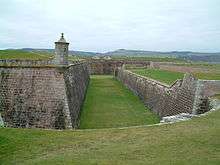
Noun
fort m inan
- fortress (fortified place)
Declension
Synonyms
- barbakan
- koszary
- twierdza
Related terms
- fortyfikacja
Swedish
Etymology 1
Attested since 1609 according to Nationalencyklopedins Ordbok, from Middle Low German fôrt (“away, further, forward”), which is used adverbially (forts) with the same meaning in Low German. Related to för ("fore"), före, ("before") and forsla ("transport; carry; haul").
Pronunciation
- IPA(key): /fʊrt/
audio (file)
Adverb
fort
See also
Etymology 2
Attested since 1651 according to Nationalencyklopedins Ordbok. From French fort.
Pronunciation
- IPA(key): /fɔrt/
Noun
fort n
- a fort
Usage notes
Declension
| Declension of fort | ||||
|---|---|---|---|---|
| Singular | Plural | |||
| Indefinite | Definite | Indefinite | Definite | |
| Nominative | fort | fortet | fort | forten |
| Genitive | forts | fortets | forts | fortens |