flamboyant
English
WOTD – 10 July 2016
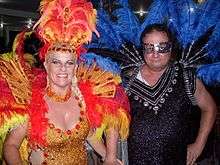
Flamboyant costumes worn during the Carnival period in Brazil
Etymology
Borrowed from French flamboyant (“flaming, wavy”), participle of flamboyer (“to flame”), from Old French flamboier, from flambe (“flame”).
Pronunciation
- (Received Pronunciation) IPA(key): /flamˈbɔɪənt/
- (General American) IPA(key): /flæmˈbɔɪ(j)ənt/
-
Audio (US) (file) - Hyphenation: flam‧boy‧ant
- Rhymes: -ɔɪ.ənt
Adjective
flamboyant (comparative more flamboyant, superlative most flamboyant)
- Showy, bold or audacious in behaviour, appearance, etc.
- 1902, G. K. Chesterton, The Optimism of Byron, in Twelve Types,
- When we see some of the monstrous and flamboyant blossoms that enrich the equatorial woods, we do not feel that they are conflagrations of nature; silent explosions of her frightful energy. We simply find it hard to believe that they are not wax flowers grown under a glass case.
- 1920, Frederic Taber Cooper, The Craftsmanship of Writing, Chapter VI: The Question of Clearness,
- But a scorn of flamboyant neckties and checkerboard trousers is no excuse for going to the opposite extreme of a blue flannel shirt and overalls; […] .
- 1962 May 12, Douglas MacArthur, Duty, honor, country,
- The unbelievers will say they are but words, but a slogan, but a flamboyant phrase.
- 1902, G. K. Chesterton, The Optimism of Byron, in Twelve Types,
- (architecture) Referring to the final stage of French Gothic architecture from the 14th to the 16th centuries.
- 1891, Sabine Baring-Gould, In Troubadour-Land: A Ramble in Provence and Languedoc, Chapter XIX: Avignon,
- S. Pierre is a flamboyant church, the details passing into Renaissance.
- 1911, Bruges, article in Encyclopædia Britannica Eleventh Edition,
- The second is a chapel of two storeys, the lower dating from 1150, while the upper was rebuilt in the 15th century, and there is a rich Flamboyant entrance with a stairway (1533).
- 1913, Abbey of Saint-Ouen, article in Catholic Encyclopedia,
- The nave and central tower, more flamboyant in design, were finished early in the sixteenth century after the original plan.
- 1891, Sabine Baring-Gould, In Troubadour-Land: A Ramble in Provence and Languedoc, Chapter XIX: Avignon,
Translations
showy, bold or audacious in behaviour, appearance, etc.
|
|
referring to the final stage of French Gothic architecture from the 14th to the 16th centuries
|
|
Noun
flamboyant (plural flamboyants)
- The royal poinciana (Delonix regia), a showy tropical tree.
- 1919, W. Somerset Maugham, The Moon and Sixpence, chapter 45
- The schooners moored to the quay are trim and neat, the little town along the bay is white and urbane, and the flamboyants, scarlet against the blue sky, flaunt their colour like a cry of passion.
- 1919, W. Somerset Maugham, The Moon and Sixpence, chapter 45
Translations
tree
|
|
Danish
Etymology
Borrowed from French flamboyant (“flaming, wavy”), present participle of flamboyer (“to flame, blaze”).
Pronunciation
Adjective
flamboyant
Inflection
| Inflection of flamboyant | |||
|---|---|---|---|
| Positive | Comparative | Superlative | |
| Common singular | flamboyant | — | —2 |
| Neuter singular | flamboyant | — | —2 |
| Plural | flamboyante | — | —2 |
| Definite attributive1 | flamboyante | — | — |
| 1) When an adjective is applied predicatively to something definite, the corresponding "indefinite" form is used. 2) The "indefinite" superlatives may not be used attributively. | |||
Synonyms
French
Verb
flamboyant
- present participle of flamboyer
Adjective
flamboyant (feminine singular flamboyante, masculine plural flamboyants, feminine plural flamboyantes)
Further reading
- “flamboyant” in le Trésor de la langue française informatisé (The Digitized Treasury of the French Language).
This article is issued from
Wiktionary.
The text is licensed under Creative Commons - Attribution - Sharealike.
Additional terms may apply for the media files.