diapason
See also: diapasón
English
Etymology
Borrowed from Latin diapason, from Ancient Greek διαπασῶν (diapasôn), that is διά (diá, “through”) + πασῶν (pasôn, “all”) (χορδῶν (khordôn, “notes”)), “through all (notes)”.
Pronunciation
- IPA(key): /daɪəˈpeɪzən/, /daɪəˈpeɪsən/
- Rhymes: -eɪzən, -eɪsən
Noun
diapason (plural diapasons)
- (music) The musical octave.
- 1818, Iamblichus; Thomas Taylor (translator), Life of Pythagoras, page 328:
- 2 to 1, which is a duple ratio, forms the [symphony] diapason
-
- (by extension, literary) The range or scope of something, especially of notes in a scale, or of a particular musical instrument.
- 1934, Henry Miller, Tropic of Cancer:
- the piano curving like a conch, corollas giving out diapasons of light […]
- 1961, Graham Greene, A Burnt-Out Case:
- he could hear nothing except the rattle of the crickets and the swelling diapason of the frogs […]
-
- (music) A tonal grouping of the flue pipes of a pipe organ.
Translations
Further reading

French
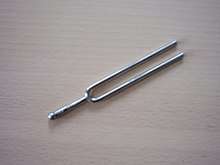
diapason (2)
Etymology
Borrowed from Latin diapason, from Ancient Greek διαπασῶν (diapasôn), that is διά (diá, “through”) + πασῶν (pasôn, “all”) (χορδῶν (khordôn, “notes”)), “through all (notes)”.
Pronunciation
- IPA(key): /dja.pa.zɔ̃/
Noun
diapason m (countable and uncountable, plural diapasons)
- (music, uncountable) range, diapason
- (countable) a tuning fork
- Synonym: accordoir
Descendants
- Portuguese: diapasão
Further reading
- “diapason” in le Trésor de la langue française informatisé (The Digitized Treasury of the French Language).
This article is issued from
Wiktionary.
The text is licensed under Creative Commons - Attribution - Sharealike.
Additional terms may apply for the media files.