curro
See also: curró
Dalmatian
Alternative forms
Etymology
Verb
curro
- to run
Galician
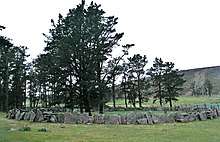
Curro do Barbanza, a corral used for gathering and marking semi-wild horses once a year
Etymology
Attested in local Latin documents since the 10th century.[1] Perhaps from Latin curro (“cart”) or from Latin curriculum.[2] Cognate with Spanish corro.
Pronunciation
- IPA(key): /ˈkuro̝/
Noun
curro m (plural curros)
- corral, round enclosure for livestock
- enclosure, wall
- 1473, M. Romaní Martínez & M. P. Rodríguez Suárez (eds.), Libro tumbo de pergamino. Un códice medieval del monasterio de Oseira. Santiago de Compostela: Tórculo, page 50:
- et outro marco esta no monte a su a mota da torre, et outro ao poonbar da torre, et outro esta na carreyra a sobre lo curro da torre
- and another boundary stone is in the hill, by the mottle of the tower, and another at the tower's dovecote, and another at the road over the tower's wall
- et outro marco esta no monte a su a mota da torre, et outro ao poonbar da torre, et outro esta na carreyra a sobre lo curro da torre
- 1473, M. Romaní Martínez & M. P. Rodríguez Suárez (eds.), Libro tumbo de pergamino. Un códice medieval del monasterio de Oseira. Santiago de Compostela: Tórculo, page 50:
- corner
Derived terms
- acurrar
- acurrullar
- acurrunchar
- curral
- curruncho
References
- “curro” in Xavier Varela Barreiro & Xavier Gómez Guinovart: Corpus Xelmírez - Corpus lingüístico da Galicia medieval. SLI / Grupo TALG / ILG, 2006-2016.
- “curro” in Dicionario de Dicionarios da lingua galega, SLI - ILGA 2006-2013.
- “curro” in Santamarina, Antón (coord.): Tesouro informatizado da lingua galega. Santiago de Compostela: Instituto da Lingua Galega.
- “curro” in Álvarez, Rosario (coord.): Tesouro do léxico patrimonial galego e portugués, Santiago de Compostela: Instituto da Lingua Galega.
- ↑ "curro" in Galleciae Monumenta Historica.
- ↑ Coromines, Joan; Pascual, José A. (1991–1997). Diccionario crítico etimológico castellano e hispánico. Madrid: Gredos, s.v. corral.
Latin
Etymology
From Proto-Italic *korzō, from Proto-Indo-European *ḱers- (“to run”).
Cognate with currus, carrus (via Gaulish), English horse.
Pronunciation
- (Classical) IPA(key): /ˈkur.roː/, [ˈkʊr.roː]
- (Ecclesiastical) IPA(key): /ˈkur.ro/
Verb
currō (present infinitive currere, perfect active cucurrī, supine cursum); third conjugation
- (intransitive) I run
- (intransitive) I hurry, hasten, speed
- (intransitive) I move, travel, proceed
- (transitive, of a race, journey, with accusative) I run
- (transitive, with accusative) I travel through, traverse, run
Inflection
Derived terms
Terms derived from curro
Descendants
Descendants of curro in other languages
- Aragonese: correr
- Aromanian: cur, curari
- Asturian: correr
- Catalan: córrer
- Corsican: corra, corre
- Dalmatian: cuar
- Emilian: córrer
- English: courier, current
- Fala: correl
- Franco-Provençal: corre, corir
- French: courir, courre
- Friulian: cori
- Galician: correr
- Guinea-Bissau Creole: kuri
- Italian: correre
- Karipúna Creole French: kuhi
- Korlai Creole Portuguese: khure
- Ladin: corer
- Kristang: curé
- Middle French: courir, corir
- Mirandese: correr
- Occitan: córrer
- Old French: courre, coure, corre
- Old Portuguese: correr
- Old Occitan: correr
- Piedmontese: cure
- Portuguese: correr
- Romagnol: còrar
- Romanian: cure, curge, curgere
- Romansch: currer, cuorer, correr, corar
- Sardinian: cúrrere, curri, cúrriri
- Sicilian: cùrriri
- Spanish: correr
- Venetian: córar, córer, córare
- Walloon: kori
References
- curro in Charlton T. Lewis and Charles Short (1879) A Latin Dictionary, Oxford: Clarendon Press
- curro in Charles du Fresne du Cange’s Glossarium Mediæ et Infimæ Latinitatis (augmented edition, 1883–1887)
- curro in Gaffiot, Félix (1934) Dictionnaire Illustré Latin-Français, Hachette
- Carl Meissner; Henry William Auden (1894) Latin Phrase-Book, London: Macmillan and Co.
- to run a foot-race: stadium currere (Off. 3. 10. 42)
- (ambiguous) to run its course in the sky: cursum conficere in caelo
- (ambiguous) to finish one's career: vitae cursum or curriculum conficere
- (ambiguous) to set one's course for a place: cursum dirigere aliquo
- (ambiguous) to hold on one's course: cursum tenere (opp. commutare and deferri)
- (ambiguous) to finish one's voyage: cursum conficere (Att. 5. 12. 1)
- to run a foot-race: stadium currere (Off. 3. 10. 42)
Spanish
Pronunciation
- IPA(key): /ˈkuro/
Adjective
curro (feminine singular curra, masculine plural curros, feminine plural curras)
- (colloquial) handsome, good looking
Noun
curro m (plural curros)
Verb
curro
Further reading
- “curro” in Diccionario de la lengua española, Vigésima tercera edición, Real Academia Española, 2014.
This article is issued from
Wiktionary.
The text is licensed under Creative Commons - Attribution - Sharealike.
Additional terms may apply for the media files.