cummerbund
English
WOTD – 16 September 2018
Etymology
.jpg)
A drawing of a cummerbund worn as part of a man’s evening wear[1]
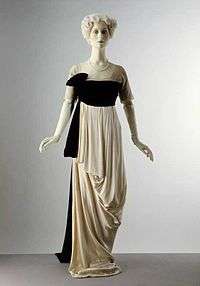
An evening dress with a black velvet cummerbund, designed about 1912 by British fashion designer Lucile (Lucy, Lady Duff-Gordon)[2]
From Hindi कमरबन्द (kamarband) and Urdu کمر بند (kamar band, “belt, waistband”), from Persian کمربند (kamarband), from کمر (kamar, “waist”) + بند (band, “band”).
Pronunciation
- (Received Pronunciation) IPA(key): /ˈkʌməbʌnd/
Audio (RP) (file) - (General American) IPA(key): /ˈkʌmɚˌbʌnd/
Audio (GA) (file) - Hyphenation: cum‧mer‧bund
Noun
cummerbund (plural cummerbunds)
- (fashion) A broad sash, especially one that is pleated lengthwise and worn as an article of formal dress, as around a man's waist together with a tuxedo or dinner jacket. [from early 17th c.]
- 1927, F[anny] E[mily Farr] Penny, chapter 4, in Pulling the Strings, London: Hodder and Stoughton, OCLC 14705422, OL 16814587W:
- Soon after the arrival of Mrs. Campbell, dinner was announced by Abboye. He came into the drawing room resplendent in his gold-and-white turban. […] His cummerbund matched the turban in gold lines.
- 2005 June 13, Edmund White, “My Women: Learning How to Love Them”, in The New Yorker, archived from the original on 10 May 2016:
- The thin boys with their brush cuts and spotty faces, their dinner jackets and burgundy cummerbunds with matching bow ties, would gape at us.
-
Alternative forms
Descendants
- German: Kummerbund
Translations
broad sash
|
References
- ↑ By David Ring, from the collection of the ModeMuseum Provincie Antwerpen (Fashion Museum of the Province of Antwerp) in Antwerp, Belgium.
- ↑ From the collection of the Victoria and Albert Museum, London, England, UK.
Further reading

This article is issued from
Wiktionary.
The text is licensed under Creative Commons - Attribution - Sharealike.
Additional terms may apply for the media files.