clamp
English
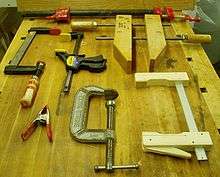
an assortment of clamps
Etymology
From Middle Dutch clamp, klampe (“a clamp, hook”), from Proto-Germanic *klampō (“clamp, clasp, cramp”). Cognate with Middle Low German klampe (“hook, clasp”), German Klampfe, Klampe (“clamp, cleat”), Norwegian klamp (“clamp”).
Pronunciation
- IPA(key): /klæmp/
-
Audio (US) (file) - Rhymes: -æmp
Noun
clamp (plural clamps)
- A brace, band, or clasp for strengthening or holding things together.
- (medicine) An instrument used to temporarily shut off blood vessels, etc.
- A mass of bricks heaped up to be burned; or of ore for roasting, or of coal coking.
- A piece of wood (batten) across the grain of a board end to keep it flat, as in a breadboard.
- A heavy footstep; a tramp.
- (electronics) An electronic circuit that fixes either the positive or the negative peak excursions of a signal to a defined value by shifting its DC value.
Derived terms
Translations
woodworking tool
|
|
surgical instrument
|
|
References

Verb
clamp (third-person singular simple present clamps, present participle clamping, simple past and past participle clamped)
- (transitive, intransitive) To fasten in place or together with (or as if with) a clamp.
- 1897, Bram Stoker, Dracula Chapter 21
- As we burst into the room, the Count turned his face, and the hellish look that I had heard described seemed to leap into it. His eyes flamed red with devilish passion. The great nostrils of the white aquiline nose opened wide and quivered at the edge, and the white sharp teeth, behind the full lips of the blood dripping mouth, clamped together like those of a wild beast.
- 1897, Bram Stoker, Dracula Chapter 21
- (intransitive, dated) To tread heavily or clumsily; to clump or clomp.
- Thackeray
- The policeman with clamping feet.
- Thackeray
- (transitive) To hold or grip tightly.
- (transitive) To modify (a numeric value) so it lies within a specific range.
- 2016, Jason Zink, Matt Pettineo, Jack Hoxley, Practical Rendering and Computation with Direct3D 11 (page 253)
- After the depth range is clamped, the depth value is read from the depth stencil buffer, and the two values are compared with a selectable depth-comparison function […]
- 2016, Jason Zink, Matt Pettineo, Jack Hoxley, Practical Rendering and Computation with Direct3D 11 (page 253)
- (Britain, obsolete, transitive) To cover (vegetables, etc.) with earth.
Derived terms
Translations
to fasten in place or together
See also
This article is issued from
Wiktionary.
The text is licensed under Creative Commons - Attribution - Sharealike.
Additional terms may apply for the media files.