castro
Catalan
Verb
castro
- first-person singular present indicative form of castrar
Galician
Etymology
From Old Portuguese castro, from Latin castrum. Cognate with Portuguese castro, Spanish castro. See also alcázar, which entered through Arabic.
Pronunciation
- IPA(key): /ˈkastɾo̝/
Noun
castro m (plural castros)
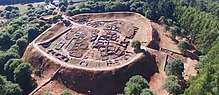
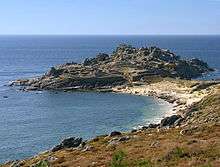
- a local fortified Iron Age village, of which some 3,000 are known in Galicia
- (by extension) any fortified archaeological site
Derived terms
References
- “castro” in Dicionario de Dicionarios do galego medieval, SLI - ILGA 2006-2012.
- “castro” in Dicionario de Dicionarios da lingua galega, SLI - ILGA 2006-2013.
- “castro” in Santamarina, Antón (coord.): Tesouro informatizado da lingua galega. Santiago de Compostela: Instituto da Lingua Galega.
- “castro” in Álvarez, Rosario (coord.): Tesouro do léxico patrimonial galego e portugués, Santiago de Compostela: Instituto da Lingua Galega.
Italian
Verb
castro
- first-person singular present indicative of castrare
Anagrams
Latin
Etymology
Denominative in -ō from a lost instrumental noun, Proto-Italic *kastrom (“knife”), maybe from Proto-Indo-European *ḱes- (“to cut up, to slaughter”). See also castrum, careō.
Pronunciation
- (Classical) IPA(key): /ˈkas.troː/
Verb
castrō (present infinitive castrāre, perfect active castrāvī, supine castrātum); first conjugation
Inflection
Derived terms
- castrātus
- castrātiō
Descendants
References
- castro in Charlton T. Lewis and Charles Short (1879) A Latin Dictionary, Oxford: Clarendon Press
- castro in Charlton T. Lewis (1891) An Elementary Latin Dictionary, New York: Harper & Brothers
- castro in Charles du Fresne du Cange’s Glossarium Mediæ et Infimæ Latinitatis (augmented edition, 1883–1887)
- castro in Gaffiot, Félix (1934) Dictionnaire Illustré Latin-Français, Hachette
- Pokorny, Julius (1959) Indogermanisches etymologisches Wörterbuch [Indo-European Etymological Dictionary] (in German), volume II, Bern, München: Francke Verlag, page 586
Portuguese
Pronunciation
Etymology 1
From Old Portuguese castro, from Latin castrum, from Proto-Indo-European *kes- (“to cut, cut off, separate”). Cognate with Galician castro, Spanish castro. Doublet of alcácer, from Arabic.
Noun
castro m (plural castros)
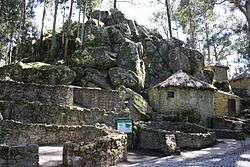
- fort (of Roman or prehistoric origin)
- a fortified pre-Roman Iron Age village frequently found in the northwestern regions of the Iberian Peninsula
Derived terms
Related terms
See also
- cividade
- citânia
Etymology 2
Verb
castro
Spanish
Etymology
From Old Spanish castro, from Latin castrum. Doublet of alcázar, which came through Arabic.
Noun
castro m (plural castros)
Related terms
Verb
castro