canga
Asturian
Noun
canga f (plural cangues)
Galician
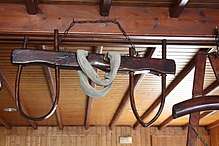
A Galician xugo or canga
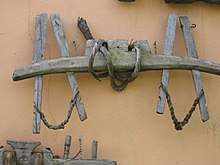
A Galician xugo or canga
Etymology
From a pre-Roman substrate of Iberia *cambica ("bent log"), from Proto-Celtic *kambos (“twisted, crooked”),[1] from Proto-Indo-European *(s)kh₂emb- (“to bend, curve”).
Pronunciation
- IPA(key): /ˈkaŋɡa̝/, (western) /ˈkaŋka̝/
Noun
canga f (plural cangas)
- yoke (frame for joining oxen by the neck)
- Synonym: xugo
- part of the yoke that surrounds the neck of the ox
- any similar gorget or collar used to impede de access of animals to gardens or orchards
- twig of a bunch of grapes
Derived terms
- canga baixa
- cangallo
- cangar
- cangada
- cangado
- escangallar
Related terms
References
- “canga” in Xavier Varela Barreiro & Xavier Gómez Guinovart: Corpus Xelmírez - Corpus lingüístico da Galicia medieval. SLI / Grupo TALG / ILG, 2006-2016.
- “canga” in Dicionario de Dicionarios da lingua galega, SLI - ILGA 2006-2013.
- “canga” in Santamarina, Antón (coord.): Tesouro informatizado da lingua galega. Santiago de Compostela: Instituto da Lingua Galega.
- “canga” in Álvarez, Rosario (coord.): Tesouro do léxico patrimonial galego e portugués, Santiago de Compostela: Instituto da Lingua Galega.
- ↑ Coromines, Joan; Pascual, José A. (1991–1997). Diccionario crítico etimológico castellano e hispánico. Madrid: Gredos, s.v. canga.
Portuguese
Etymology
Probably from Bantu, cf. Swahili "kanga" (cloth)
Noun
canga f (plural cangas)
- yoke (bar place over the shoulders for a person to carry a pair of heavy objects)
- yoke (frame for joining oxen by the neck)
Synonyms
- (frame for joining oxen): jugo
This article is issued from
Wiktionary.
The text is licensed under Creative Commons - Attribution - Sharealike.
Additional terms may apply for the media files.