barber
English
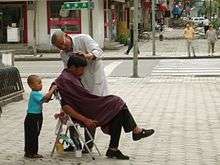
A barber cuts hair on the streets of Harbin, China.
Etymology
From Anglo-Norman barbour, from Old French barbeor, from barbe (“beard”), from Latin barba.
Pronunciation
- (UK) IPA(key): /ˈbɑː.bə/
- (General American) IPA(key): /ˈbɑɹ.bɚ/
Audio (US) (file) - Rhymes: -ɑː(ɹ)bə(ɹ)
Noun
barber (plural barbers)
- A person whose profession is cutting (usually male) customers' hair and beards.
- A barber surgeon, a foot soldier specializing in treating battlefield injuries.
- (Canada) A storm accompanied by driving ice spicules formed from sea water, especially one occurring on the Gulf of St. Lawrence; so named from the cutting ice spicules.
Synonyms
- hairdresser, hair-dresser
- hairstylist, hair-stylist
Derived terms
Terms derived from barber (noun)
Translations
person whose profession is cutting (usually male) customers' hair and beards
|
|
Verb
barber (third-person singular simple present barbers, present participle barbering, simple past and past participle barbered)
- To cut the hair or beard of (a person).
- (US, slang) To chatter, talk.
- 1940, Raymond Chandler, Farewell, My Lovely, Penguin 2010, p. 29:
- ‘I shouldn't ought to barber with you. But when I like a guy, the ceiling's the limit.’
- 1940, Raymond Chandler, Farewell, My Lovely, Penguin 2010, p. 29:
Translations
to cut the hair
Anagrams
Catalan
Etymology
Noun
Further reading
- “barber” in Diccionari de la llengua catalana, segona edició, Institut d’Estudis Catalans.
French
Etymology
From barbe + -er; compare with familiar sense of raser which was its original meaning in Old French.
Pronunciation
- IPA(key): /baʁ.be/
Verb
barber
- (familiar) to bore someone
- Le fait est qu'il ne perd aucune occasion de nous barber avec ses expériences dramatiques. (Claudel, Le Ravissement de Scapin, 1952)
Conjugation
Conjugation of barber (see also Appendix:French verbs)
| simple | compound | ||||||
|---|---|---|---|---|---|---|---|
| infinitive | barber | avoir barbé | |||||
| gerund | en barbant | en ayant barbé | |||||
| present participle | barbant /baʁ.bɑ̃/ | ||||||
| past participle | barbé /baʁ.be/ | ||||||
| person | singular | plural | |||||
| first | second | third | first | second | third | ||
| indicative | je (j’) | tu | il | nous | vous | ils | |
| simple tenses |
present | barbe /baʁb/ |
barbes /baʁb/ |
barbe /baʁb/ |
barbons /baʁ.bɔ̃/ |
barbez /baʁ.be/ |
barbent /baʁb/ |
| imperfect | barbais /baʁ.bɛ/ |
barbais /baʁ.bɛ/ |
barbait /baʁ.bɛ/ |
barbions /baʁ.bjɔ̃/ |
barbiez /baʁ.bje/ |
barbaient /baʁ.bɛ/ | |
| past historic1 | barbai /baʁ.be/ |
barbas /baʁ.ba/ |
barba /baʁ.ba/ |
barbâmes /baʁ.bam/ |
barbâtes /baʁ.bat/ |
barbèrent /baʁ.bɛʁ/ | |
| future | barberai /baʁ.bə.ʁe/ |
barberas /baʁ.bə.ʁa/ |
barbera /baʁ.bə.ʁa/ |
barberons /baʁ.bə.ʁɔ̃/ |
barberez /baʁ.bə.ʁe/ |
barberont /baʁ.bə.ʁɔ̃/ | |
| conditional | barberais /baʁ.bə.ʁɛ/ |
barberais /baʁ.bə.ʁɛ/ |
barberait /baʁ.bə.ʁɛ/ |
barberions /baʁ.bə.ʁjɔ̃/ |
barberiez /baʁ.bə.ʁje/ |
barberaient /baʁ.bə.ʁɛ/ | |
| compound tenses |
present perfect | Use the present tense of avoir followed by the past participle | |||||
| pluperfect | Use the imperfect tense of avoir followed by the past participle | ||||||
| past anterior1 | Use the past historic tense of avoir followed by the past participle | ||||||
| future perfect | Use the future tense of avoir followed by the past participle | ||||||
| conditional perfect | Use the conditional tense of avoir followed by the past participle | ||||||
| subjunctive | que je (j’) | que tu | qu’il | que nous | que vous | qu’ils | |
| simple tenses |
present | barbe /baʁb/ |
barbes /baʁb/ |
barbe /baʁb/ |
barbions /baʁ.bjɔ̃/ |
barbiez /baʁ.bje/ |
barbent /baʁb/ |
| imperfect1 | barbasse /baʁ.bas/ |
barbasses /baʁ.bas/ |
barbât /baʁ.ba/ |
barbassions /baʁ.ba.sjɔ̃/ |
barbassiez /baʁ.ba.sje/ |
barbassent /baʁ.bas/ | |
| compound tenses |
past | Use the present subjunctive tense of avoir followed by the past participle | |||||
| pluperfect1 | Use the imperfect subjunctive tense of avoir followed by the past participle | ||||||
| imperative | – | tu | – | nous | vous | – | |
| — | barbe /baʁb/ |
— | barbons /baʁ.bɔ̃/ |
barbez /baʁ.be/ |
— | ||
| 1literary tenses | |||||||
Derived terms
References
- “barber” in le Trésor de la langue française informatisé (The Digitized Treasury of the French Language).
Further reading
- “barber” in le Trésor de la langue française informatisé (The Digitized Treasury of the French Language).
Norwegian Bokmål
Verb
barber
- imperative of barbere
This article is issued from
Wiktionary.
The text is licensed under Creative Commons - Attribution - Sharealike.
Additional terms may apply for the media files.