arabesque
English
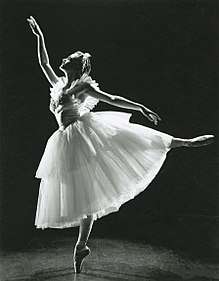
An arabesque (ballet).

Etymology
Borrowed from French arabesque, from Italian arabesco, from arabo (“Arab”).
Pronunciation
Noun
arabesque (plural arabesques)
- An elaborate design of intertwined floral figures or complex geometrical patterns. This ornamental design is mainly used in Islamic Art and architecture.
- 1907, Robert William Chambers, chapter V, in The Younger Set (Project Gutenberg; EBook #14852), New York, N.Y.: D. Appleton & Company, published 1 February 2005 (Project Gutenberg version), OCLC 24962326:
- The house of Ruthven was a small but ultra-modern limestone affair, between Madison and Fifth ; […]. As a matter of fact its narrow ornate façade presented not a single quiet space that the eyes might rest on after a tiring attempt to follow and codify the arabesques, foliations, and intricate vermiculations of what some disrespectfully dubbed as “ near-aissance.”
-
- (music) An ornate composition, especially for the piano.
- (ballet) A dance position in which the dancer stands on one leg, with the other raised backwards, and the arms outstretched.
- elaborate/ornate creations in general
- 1840 Edgar Allen Poe, "Tales of the Grotesque and Arabesque"
- 2003 Robert Irwin, Arabian Nights: A Companion
- In characterizing some of his tales as 'Arabesque', Poe intended no specific reference to the Arab manner of telling stories. He only used the term to refer to intricately patterned tales
Translations
ornamental design used in Islamic Art
(music) ornate composition
French
Etymology
Noun
arabesque f (plural arabesques)
Adjective
arabesque (plural arabesques)
- (obsolete) Arabic (relating to Arabic peoples)
Further reading
- “arabesque” in le Trésor de la langue française informatisé (The Digitized Treasury of the French Language).
This article is issued from
Wiktionary.
The text is licensed under Creative Commons - Attribution - Sharealike.
Additional terms may apply for the media files.